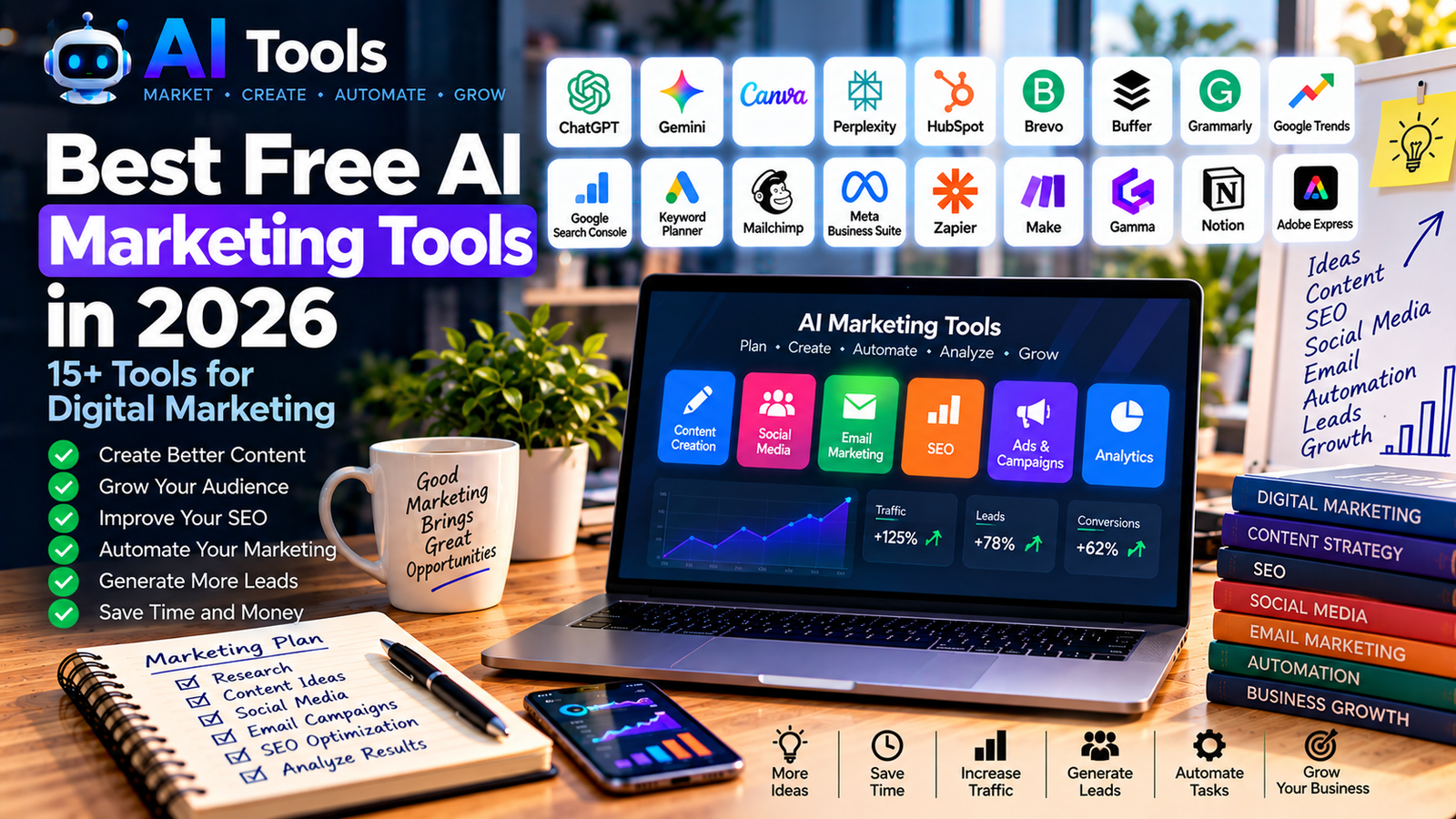
Best Free AI Marketing Tools in 2026
Digital marketing involves many repetitive tasks.
Marketers need to research audiences, create content, write advertisements, manage social media, send emails, analyze competitors and generate leads.
AI can help simplify many of these activities.
In this guide, we have selected 15+ free AI marketing tools in 2026 for content creation, SEO, social media, email marketing, advertising, research and marketing automation.
Whether you are a small business owner, freelancer, blogger, marketer or agency, these tools can help you build a more efficient marketing workflow.
If you are interested in AI tools for broader business tasks, see our guide to free AI business tools.
What Are AI Marketing Tools?
AI marketing tools are applications that use artificial intelligence to help businesses plan, create, optimize or automate marketing activities.
They can help with:
- Content creation
- SEO research
- Keyword research
- Social media
- Email marketing
- Advertising
- Customer research
- Competitor analysis
- Lead generation
- Marketing automation
- Analytics
- Copywriting
Some tools are specifically designed for marketing, while others are general AI assistants that can be adapted to marketing workflows.
1. ChatGPT
Best for: Marketing ideas and content creation
ChatGPT can support almost every stage of a digital marketing workflow.
Marketers can use it to brainstorm campaigns, create content ideas, write advertising copy, develop email campaigns and analyze customer personas.
Marketing uses:
- Marketing strategies
- Blog ideas
- Ad copy
- Email campaigns
- Social media posts
- Customer personas
- Content calendars
- Campaign brainstorming
It can be particularly useful for small businesses that need marketing assistance without hiring a large team.
For more writing-focused platforms, see our guide to free AI writing tools.
2. Google Gemini
Best for: Marketing research and brainstorming
Gemini can help marketers research topics, generate ideas and organize marketing campaigns.
Marketing uses:
- Campaign ideas
- Market research
- Content planning
- Customer research
- Social media ideas
- Marketing copy
- Brainstorming
It can be used alongside other research and analytics tools to build a broader marketing workflow.
3. Canva
Best for: Marketing graphics
Canva is one of the most accessible tools for creating marketing visuals.
Businesses can create social media graphics, advertisements, presentations, flyers, banners and other promotional materials.
Marketing uses:
- Social media graphics
- Advertisements
- Posters
- Flyers
- Presentations
- Instagram content
- Marketing banners
Its AI features can also help accelerate certain design and content-creation tasks.
If you need AI-generated images specifically, see our guide to free AI image generators.
4. Perplexity
Best for: Marketing research
Perplexity can help marketers investigate industries, competitors, products and customer-related topics.
It can be useful during the research stage of a campaign.
Marketing uses:
- Competitor research
- Market research
- Product research
- Industry research
- Trend research
- Content research
- Source discovery
Important claims should always be checked against the original sources.
5. HubSpot
Best for: CRM and inbound marketing
HubSpot provides tools for customer relationship management, sales and marketing.
Its free CRM can be useful for businesses that need to organize contacts, leads and customer interactions.
Marketing uses:
- Lead management
- Contact management
- Customer data
- Marketing campaigns
- Sales pipelines
- Email marketing
- Customer communication
HubSpot also incorporates AI capabilities across parts of its platform.
6. Brevo
Best for: Email marketing
Brevo provides email marketing and customer communication tools.
Small businesses can use it to create campaigns, manage contacts and communicate with customers.
Marketing uses:
- Newsletters
- Promotional emails
- Customer communication
- Email campaigns
- Contact management
- Marketing automation
Its free plan provides an accessible starting point, although usage limits apply.
7. Buffer
Best for: Social media marketing
Buffer helps businesses and creators schedule social media content.
Instead of publishing every post manually, marketers can prepare content in advance.
Marketing uses:
- Social media scheduling
- Content calendars
- Social posts
- Campaign planning
- Publishing
- Content organization
It can be particularly useful for small businesses managing several social networks.
8. Grammarly
Best for: Marketing copy editing
Marketing messages need to be clear and easy to understand.
Grammarly can help marketers identify grammar, spelling and clarity problems in their copy.
Marketing uses:
- Advertising copy
- Emails
- Blog posts
- Landing pages
- Social media
- Website content
- Newsletters
It can serve as an additional editing step before marketing content is published.
9. Google Trends
Best for: Discovering search trends
Google Trends is not exclusively an AI tool, but it is an important free resource for marketers.
It helps users explore how search interest changes over time and compare topics.
Marketing uses:
- Trend discovery
- Content ideas
- Keyword research
- Seasonal campaigns
- Market research
- Topic comparison
Combining trend data with an AI assistant can help marketers turn search trends into content ideas.
10. Google Search Console
Best for: SEO performance analysis
Google Search Console is a free Google service that helps website owners understand how their pages perform in Google Search.
It can provide information about:
- Search queries
- Clicks
- Impressions
- Search positions
- Indexed pages
- Technical SEO issues
Marketers can combine Search Console data with AI tools to identify content opportunities and organize SEO improvements.
11. Google Keyword Planner
Best for: Keyword research
Google Keyword Planner is designed primarily for advertisers, but it can also provide useful keyword and search-demand information.
Marketers can use it to discover related search terms and investigate potential keywords.
Marketing uses:
- Keyword research
- Search demand
- Campaign planning
- Content ideas
- Advertising research
It is especially useful when planning Google Ads campaigns.
12. Mailchimp
Best for: Email marketing
Mailchimp provides tools for email marketing and audience management.
Marketers can use it to create campaigns, manage subscribers and communicate with their audience.
Marketing uses:
- Email newsletters
- Customer communication
- Marketing campaigns
- Audience management
- Promotional emails
- Email automation
The available free features and limits can change, so check the current plan before choosing it for a larger campaign.
13. Meta Business Suite
Best for: Facebook and Instagram marketing
Meta Business Suite provides tools for businesses managing their presence across Meta platforms.
It can help with publishing, messaging and managing social content.
Marketing uses:
- Facebook content
- Instagram content
- Social scheduling
- Customer messages
- Content management
- Business communication
Businesses running Meta advertising campaigns can use it as part of their broader social media workflow.
14. Zapier
Best for: Marketing automation
Zapier can connect different applications and automate repetitive marketing processes.
For example, a business could automatically send information from a form to a spreadsheet, CRM or email platform.
Marketing uses:
- Lead automation
- Form processing
- Email workflows
- CRM automation
- Notifications
- Marketing processes
For more automation platforms, see our guide to free AI automation tools.
15. Make
Best for: Advanced marketing workflows
Make provides visual automation workflows that can connect different applications.
It can be useful when marketers need more complex workflows involving multiple steps.
Marketing uses:
- Lead management
- Marketing automation
- Data synchronization
- Email workflows
- Customer data
- Content workflows
Its visual workflow builder makes it possible to see how information moves between different applications.
16. Gamma
Best for: Marketing presentations
Gamma can help marketers transform ideas and information into presentations and visual documents.
Marketing uses:
- Sales presentations
- Marketing proposals
- Pitch decks
- Reports
- Campaign presentations
- Client presentations
This can save time when a marketer needs to turn research into a professional-looking presentation.
17. Notion
Best for: Marketing organization
Notion can serve as a central workspace for marketing teams and individual marketers.
You can organize content calendars, campaign ideas, research, tasks and marketing documents.
Marketing uses:
- Content calendars
- Campaign planning
- Marketing ideas
- Research
- Task management
- Content organization
A good organizational system can make an AI-assisted marketing workflow much easier to manage.
Best Free AI Marketing Tools by Task
For content marketing
Consider:
- ChatGPT
- Claude
- Gemini
- Grammarly
For social media
Consider:
- Canva
- Buffer
- Meta Business Suite
- ChatGPT
For email marketing
Consider:
- Brevo
- Mailchimp
- ChatGPT
For SEO
Consider:
- Google Search Console
- Google Trends
- Google Keyword Planner
- ChatGPT
- Perplexity
For market research
Consider:
- Perplexity
- Gemini
- ChatGPT
- Google Trends
For marketing automation
Consider:
- Zapier
- Make
For presentations
Consider:
- Gamma
- Canva
- ChatGPT
How to Build a Free AI Marketing Stack
You don’t need a large collection of expensive marketing software.
A small business could start with:
Research: Perplexity + Google Trends
Writing: ChatGPT + Grammarly
Design: Canva
Social media: Buffer + Meta Business Suite
Email: Brevo
CRM: HubSpot
SEO: Google Search Console
Automation: Zapier or Make
Organization: Notion
This combination can cover a large portion of the basic digital marketing workflow.
AI Marketing Workflow for a Small Business
Step 1 — Research your audience
Identify customer problems, questions and interests.
Use research tools and AI assistants to organize your findings.
Step 2 — Find content opportunities
Use Google Trends, Search Console and keyword research tools to identify potential topics.
Step 3 — Create a content plan
Use ChatGPT or Gemini to turn your research into a monthly content calendar.
Step 4 — Create the content
Write articles, emails and social media posts with the help of AI.
Step 5 — Create visuals
Use Canva to create social media graphics and promotional materials.
Step 6 — Publish
Use your website and social media platforms to distribute the content.
Step 7 — Automate repetitive tasks
Use Zapier or Make to connect forms, email systems, spreadsheets and CRM tools.
Step 8 — Analyze the results
Review traffic, search performance, engagement and conversions.
Then use those results to improve the next campaign.
How AI Can Help With SEO
AI can assist marketers with:
- Content ideas
- Search-intent analysis
- Article outlines
- Title ideas
- Meta descriptions
- FAQ ideas
- Content optimization
- Internal-link suggestions
However, AI should not be used simply to generate large volumes of low-quality pages.
Useful content should provide original information, practical value and a good experience for readers.
How AI Can Help With Social Media Marketing
AI can help create:
- Post ideas
- Captions
- Video scripts
- Content calendars
- Advertising concepts
- Visual ideas
- Promotional messages
A useful workflow is to create one core piece of content and then adapt it to different platforms.
For example:
Blog article
↓
LinkedIn post
↓
Facebook post
↓
Instagram caption
↓
Short video script
↓
Email newsletter
This allows marketers to get more value from the same research.
How AI Can Help With Email Marketing
AI can help marketers create:
- Subject lines
- Email introductions
- Promotional messages
- Newsletter ideas
- Follow-up emails
- Customer segmentation ideas
- A/B test variations
But marketers should still review every message before sending it.
AI-generated email should sound natural and match the brand’s voice.
How AI Can Help With Advertising
AI can help marketers brainstorm different advertising concepts.
For example, you can ask an AI assistant to create variations based on:
- Customer problem
- Product benefit
- Target audience
- Offer
- Call to action
- Platform
A marketer can then test different versions rather than relying on one AI-generated advertisement.
Are Free AI Marketing Tools Enough?
For many small businesses, free tools can be enough to start.
A free marketing stack can cover:
- Research
- Content
- Design
- Social media
- SEO
- CRM
- Automation
However, free plans often have limitations.
These may include:
- Monthly usage limits
- Number of contacts
- Number of social accounts
- AI generation limits
- Automation tasks
- Storage
- Advanced features
As a business grows, paid plans can be evaluated based on actual usage and return on investment.
Important: AI Does Not Replace Marketing Strategy
AI can help execute marketing tasks, but it does not automatically understand your customers or your business.
Before creating content, define:
- Who is your customer?
- What problem do they have?
- What are they searching for?
- Why should they choose your business?
- What makes your offer different?
- What action should they take?
AI becomes much more useful when it receives this context.
Frequently Asked Questions
What are the best free AI marketing tools?
Different tools solve different marketing problems. ChatGPT is useful for content and ideas, Canva for visual content, Perplexity for research, Buffer for social media and Zapier or Make for automation.
Can AI help with SEO?
Yes. AI can help with content ideas, outlines, search-intent analysis, meta descriptions and content optimization. SEO data should still come from reliable sources such as Google Search Console and keyword research tools.
Can AI create social media content?
Yes. AI can generate post ideas, captions, scripts and content calendars. Human review is important before publishing.
Can AI automate marketing?
Yes. Platforms such as Zapier and Make can connect marketing applications and automate repetitive processes.
Are free AI marketing tools good for small businesses?
They can be a useful starting point. Free plans allow businesses to test workflows before deciding whether a paid subscription is necessary.
Should I use many AI marketing tools?
Not necessarily. Start with a small set of tools that solve real problems. Adding too many platforms can make your marketing workflow harder to manage.
Final Thoughts
AI is becoming an important part of digital marketing.
Small businesses can use AI to research markets, create content, design visuals, manage social media, communicate with customers and automate repetitive tasks.
The goal should not be to use as many AI tools as possible.
Instead, build a simple marketing system where each tool has a clear purpose.
Start with free tools, measure the results and only invest in paid software when it provides a clear benefit to your business.
For more business-focused AI tools, explore our guide to free AI business tools.
Leave a Reply