
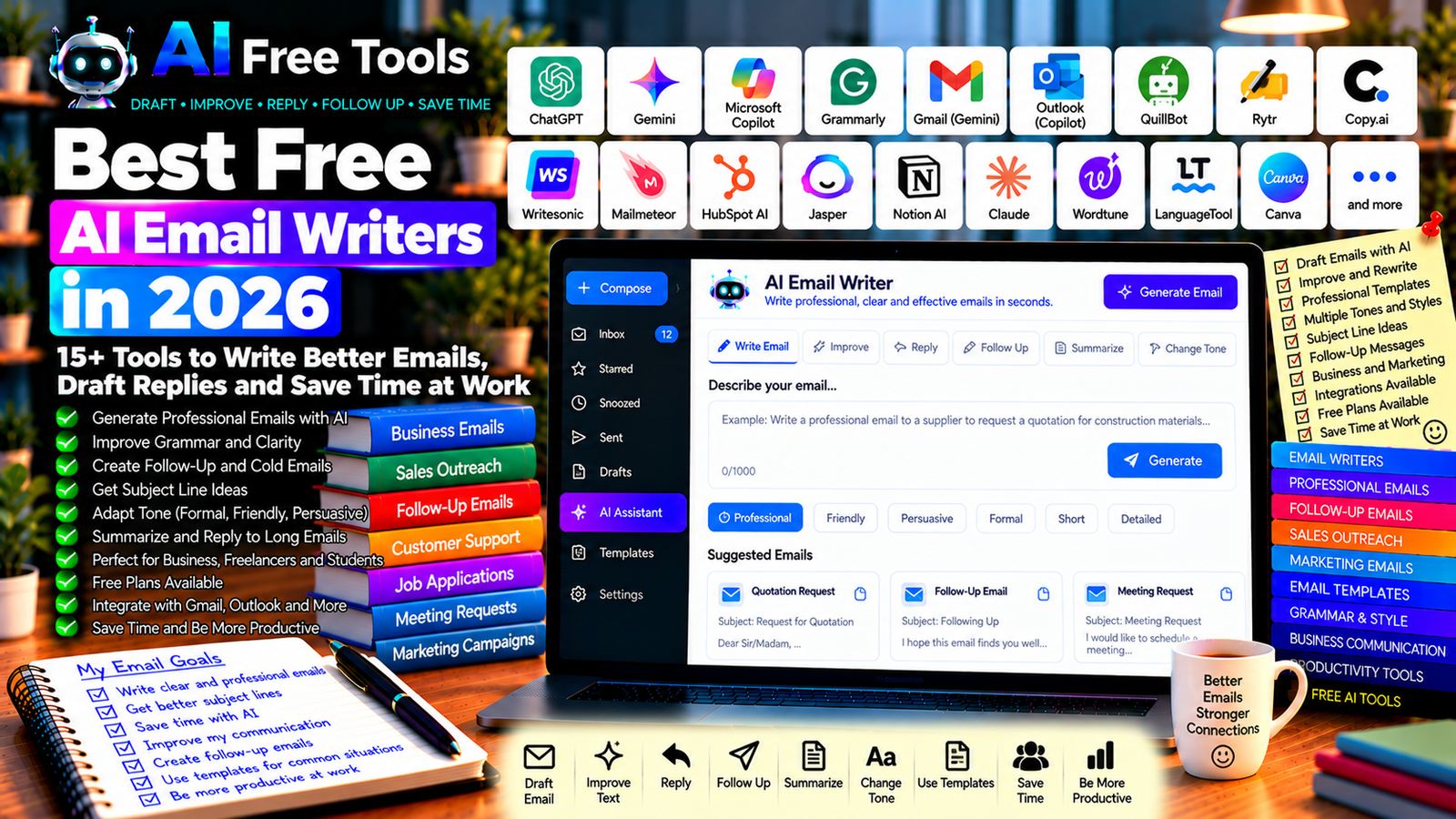
Best Free AI Email Writers in 2026: 15+ Tools to Write Better Emails
Writing emails can take more time than expected. You may need to respond to a customer, follow up with a client, request information from a supplier, apply for a job, or explain a complicated issue professionally.
Free AI email writers can help you draft messages, improve tone, correct grammar, summarize long conversations, and create clearer replies. Some tools work inside email applications, while others let you generate text in a separate AI assistant and copy it into your inbox.
In this guide, we compare 17 AI assistants, email productivity tools, and writing platforms in 2026. You will learn what each tool does best, which free options are worth exploring, and how to choose a tool that fits your workflow.
Important: Not every tool listed here is a dedicated email writer. Some are general-purpose AI assistants or grammar tools that can help you write emails. Free plans, integrations, and usage limits change, so check the current terms before choosing a tool for regular use.
Quick Comparison: Best Free AI Email Writers
| Tool | Best For | Free Access |
|---|---|---|
| ChatGPT | Drafting and rewriting emails | Free tier with limits |
| Google Gemini | Email drafts and replies | Free tier with limits |
| Microsoft Copilot | Email assistance in Microsoft workflows | Availability depends on account and plan |
| Grammarly | Grammar, clarity, and tone | Free features; advanced tools may cost |
| Claude | Natural, detailed email writing | Free tier and usage limits may vary |
| Gmail with Gemini | Email assistance inside Gmail | Features depend on account and plan |
| Microsoft Outlook with Copilot | Email summaries and drafts | AI features may require an eligible plan |
| QuillBot | Rewriting and paraphrasing | Free usage with limits |
| Rytr | Short business emails | Free usage may be limited |
| Copy.ai | Sales and marketing emails | Access and limits may vary |
| Writesonic | Marketing and outreach copy | Free access or trial limits may vary |
| Mailmeteor | Email writing and mail merge workflows | Free plan with restrictions |
| HubSpot AI | Sales and customer communication | Availability varies by product and plan |
| Jasper | Marketing email copy | Paid access or trial conditions may apply |
| Wordtune | Rewriting and improving messages | Free usage may be limited |
| Notion AI | Drafting emails from notes | AI availability depends on plan |
| LanguageTool | Grammar and style correction | Free features; advanced options may cost |
1. ChatGPT — Best for Writing Almost Any Email
ChatGPT can help draft professional emails from a short description of your situation. You can specify the recipient, the purpose, the desired tone, and the important details to include.
It is useful for business correspondence, customer support, supplier requests, follow-up messages, job applications, and everyday communication.
Best features:
- Draft emails from a short prompt.
- Rewrite a message in a more professional or friendly tone.
- Shorten long emails.
- Suggest subject lines.
- Prepare polite follow-ups and replies.
- Translate or adapt emails for different audiences.
Free access: ChatGPT offers a free tier with usage and feature limits.
Best for: Professionals, freelancers, entrepreneurs, students, and anyone who writes emails regularly.
Official website: https://chatgpt.com/
Example prompt:
“Write a professional email to [RECIPIENT] about [SUBJECT]. My objective is to [OBJECTIVE]. Include these facts: [DETAILS]. Use a polite, clear, and concise tone. Add a suitable subject line and a clear next step. Do not invent dates, prices, promises, or other facts.”
2. Google Gemini — Best for Email Drafts and Replies
Google Gemini can help write emails, summarize information, and suggest responses. It is particularly useful if you already use Google services and want assistance preparing messages before sending them.
Depending on your account and available integrations, Gemini may also support workflows connected to Google Workspace.
Best features:
- Draft business emails.
- Rewrite messages for clarity.
- Generate subject line ideas.
- Prepare follow-up emails.
- Summarize information into a concise message.
- Adapt wording for different audiences.
Free access: Gemini offers a free tier with usage limits. Workspace integrations and advanced features depend on the current account and plan.
Best for: Gmail users, students, business owners, and professionals.
Official website: https://gemini.google.com/
3. Microsoft Copilot — Best for Microsoft Workflows
Microsoft Copilot can assist with drafting, summarizing, and rewriting business communication. Its usefulness depends on which Microsoft applications and features are available to your account.
If you work with Outlook, Word, and other Microsoft products, Copilot may help streamline email-related tasks.
Best features to investigate:
- Draft and rewrite email text.
- Summarize information.
- Adjust tone and length.
- Prepare professional responses.
- Explore eligible Microsoft 365 integrations.
Free access: Availability varies by product, account, region, and subscription. Some integrated email features require an eligible paid plan.
Best for: Office workers, business teams, and users who rely on Microsoft applications.
Official website: https://copilot.microsoft.com/
4. Grammarly — Best for Grammar and Professional Tone
Grammarly helps improve grammar, spelling, clarity, and writing style. It is particularly useful when you have already written an email and want to make it more polished before sending it.
Depending on the current product and plan, Grammarly may also offer AI-assisted drafting and rewriting features.
Best features:
- Correct spelling and grammar.
- Improve clarity and readability.
- Adjust writing tone.
- Identify wordy sentences.
- Refine professional messages.
Free access: Grammarly offers free writing assistance, while advanced suggestions and some AI features may require a paid plan or have usage limits.
Best for: Professionals, students, freelancers, and anyone who wants to improve written communication.
Official website: https://www.grammarly.com/
5. Claude — Best for Natural and Detailed Emails
Claude can help write thoughtful emails when the situation requires context, careful wording, or a balanced tone. It can be useful for explaining a problem, responding to a complaint, or communicating a complex proposal.
Best features:
- Draft detailed business emails.
- Rewrite messages in a natural tone.
- Organize complex information.
- Create concise summaries.
- Suggest tactful responses to difficult situations.
Free access: Claude offers free access with usage limits that can change.
Best for: Consultants, managers, professionals, and people writing sensitive or detailed business correspondence.
Official website: https://claude.ai/
6. Gmail with Gemini — Best for Email Assistance Inside Gmail
Gmail users may have access to AI-assisted email features through Google’s available products and subscriptions. Depending on eligibility, these features can help draft messages, suggest replies, or improve wording without switching between applications.
Best features to investigate:
- Generate email drafts.
- Improve the wording of a message.
- Prepare suggested replies.
- Summarize relevant information.
- Use supported Gmail-integrated assistance.
Free access: Features depend on the current Google account, region, and plan. Do not assume every Gemini feature is available in every Gmail account.
Best for: People who manage most of their communication through Gmail.
Official website: https://mail.google.com/
7. Microsoft Outlook with Copilot — Best for Business Email Workflows
Outlook is widely used for professional email and calendar management. Eligible Copilot features can help users draft messages, summarize email threads, and prepare replies.
This option is particularly relevant if your organization already uses Microsoft 365.
Best features to investigate:
- Draft professional emails.
- Summarize long conversations.
- Prepare replies using relevant context.
- Adjust tone and length.
- Explore available Outlook integrations.
Free access: Integrated Copilot features may require an eligible subscription or organizational license. Check your account’s current capabilities.
Best for: Business users, managers, and teams working with Outlook.
Official website: https://outlook.office.com/
8. QuillBot — Best for Rewriting Existing Emails
QuillBot is a writing assistant with paraphrasing and editing tools. It can help you improve an email that is too long, unclear, repetitive, or awkwardly phrased.
It is especially useful when you already know what you want to say but need help expressing it more effectively.
Best features:
- Rewrite sentences and paragraphs.
- Explore alternative wording.
- Improve clarity.
- Shorten repetitive messages.
- Check grammar through supported tools.
Free access: QuillBot offers free tools with restrictions on usage, modes, or text length. Verify the current limits.
Best for: Students, freelancers, professionals, and non-native English writers.
Official website: https://quillbot.com/
9. Rytr — Best for Short Business Emails
Rytr is an AI writing assistant for short-form content and business communication. It can help generate email drafts, outreach messages, and follow-ups from a short description.
Best features:
- Draft short emails.
- Generate follow-up messages.
- Explore different tones.
- Rewrite existing text.
- Create other business content when needed.
Free access: Rytr has offered free usage with restrictions. Check current monthly limits and available features.
Best for: Freelancers, small businesses, and users who need quick email drafts.
Official website: https://rytr.me/
10. Copy.ai — Best for Sales and Marketing Emails
Copy.ai focuses on AI-assisted marketing and business writing. It can help prepare outreach messages, sales emails, campaign copy, and customer communication.
Best features:
- Draft sales outreach emails.
- Generate promotional email copy.
- Explore subject lines.
- Adapt messages to different audiences.
- Develop alternative calls to action.
Free access: Access conditions, credits, and features may change. Check the current plan before using it for regular campaigns.
Best for: Sales professionals, marketers, agencies, and business owners.
Official website: https://www.copy.ai/
11. Writesonic — Best for Marketing and Outreach Copy
Writesonic offers AI-assisted writing tools for marketing, business content, and promotional communication. It can help generate email drafts and variations for different campaign objectives.
Best features:
- Create promotional email drafts.
- Generate subject line ideas.
- Adapt copy to different audiences.
- Rewrite messages for clarity.
- Produce alternative marketing angles.
Free access: Free access or trial conditions may change, and ongoing use may require payment.
Best for: Digital marketers, online stores, and small businesses.
Official website: https://writesonic.com/
12. Mailmeteor — Best for Email Outreach Workflows
Mailmeteor is associated with email outreach and mail merge workflows, including sending personalized messages to multiple recipients through supported email services.
It can be useful when you need to prepare many individual messages, but you should distinguish email drafting from bulk sending and follow the provider’s usage rules.
Best features to investigate:
- Personalize messages using recipient data.
- Prepare mail merge campaigns.
- Work with supported email platforms.
- Organize outreach workflows.
- Explore AI-assisted writing features where available.
Free access: Mailmeteor offers plan options with restrictions that may include sending limits, recipients, or advanced features. Check current terms.
Best for: Recruiters, small businesses, educators, and professionals managing legitimate outreach.
Official website: https://mailmeteor.com/
13. HubSpot AI — Best for Sales and Customer Communication
HubSpot offers CRM and marketing tools, with AI-assisted capabilities available across some workflows. These can help businesses prepare sales emails, customer responses, and marketing messages.
Best features to investigate:
- Draft sales emails.
- Prepare customer follow-ups.
- Adapt messaging to different stages of a sales process.
- Organize communication around customer records.
- Explore eligible CRM and marketing integrations.
Free access: HubSpot offers some free CRM tools, but AI capabilities and advanced features vary by product and plan.
Best for: Sales teams, customer-facing businesses, and companies managing leads.
Official website: https://www.hubspot.com/
14. Jasper — Best for Marketing Email Campaigns
Jasper is an AI marketing platform designed for businesses and marketing teams. It can help develop promotional emails, campaign messaging, and consistent brand communication.
Best features to investigate:
- Generate marketing email drafts.
- Adapt content to a brand voice.
- Develop subject lines and calls to action.
- Create variations for campaigns.
- Support broader marketing content workflows.
Free access: Jasper may require a paid plan or offer limited trial conditions. Verify the current pricing before relying on it.
Best for: Marketing teams, agencies, and businesses with recurring campaign needs.
Official website: https://www.jasper.ai/
15. Wordtune — Best for Rewriting and Improving Messages
Wordtune focuses on rewriting text to make it clearer, more concise, or better suited to a particular tone. It is useful when you have written an email but want to improve the wording.
Best features:
- Rewrite sentences.
- Shorten long messages.
- Explore alternative expressions.
- Improve readability.
- Refine the tone of professional communication.
Free access: Wordtune offers access options with usage limits. Check the current plan before using it for frequent editing.
Best for: Professionals, students, writers, and anyone who wants clearer emails.
Official website: https://www.wordtune.com/
16. Notion AI — Best for Turning Notes into Emails
Notion is a workspace for notes, documents, projects, and knowledge management. Its AI capabilities, where available, can help turn meeting notes, task lists, or rough ideas into a structured email draft.
Best features to investigate:
- Convert notes into email drafts.
- Summarize meeting information.
- Organize action items.
- Rewrite text for a professional audience.
- Keep related project information together.
Free access: AI availability and usage depend on the current Notion plan and account conditions. Verify whether your plan includes the AI features you need.
Best for: Project managers, teams, consultants, and people who write emails from meeting notes.
Official website: https://www.notion.so/
17. LanguageTool — Best for Grammar and Style Correction
LanguageTool is a writing assistant that checks grammar, spelling, punctuation, and style in supported languages. It can help make emails clearer and more professional before sending them.
Best features:
- Check spelling and grammar.
- Identify punctuation problems.
- Improve sentence structure.
- Review writing in multiple supported languages.
- Use supported browser or application integrations.
Free access: LanguageTool offers free correction features, while advanced style suggestions and other options may require a paid plan.
Best for: Multilingual professionals, students, and people writing emails in English or other supported languages.
Official website: https://languagetool.org/
How to Choose the Best Free AI Email Writer
The right tool depends on whether you need a new draft, a correction, an email integrated into your inbox, or a complete marketing workflow.
| Your Main Goal | Recommended Starting Tools |
|---|---|
| Write an email from scratch | ChatGPT or Gemini |
| Improve grammar and clarity | Grammarly or LanguageTool |
| Rewrite an existing message | QuillBot or Wordtune |
| Draft emails inside Gmail | Gmail with eligible Gemini features |
| Draft emails in Outlook | Outlook with eligible Copilot features |
| Create sales outreach | Copy.ai or HubSpot AI |
| Prepare marketing campaigns | Writesonic or Jasper |
| Turn meeting notes into emails | Notion AI or ChatGPT |
| Personalize legitimate email outreach | Mailmeteor |
Best Free AI Email Writers for Business
Business emails should be clear, polite, and specific. Whether you are contacting a supplier, replying to a customer, requesting a quotation, or discussing an invoice, the message should communicate the objective without unnecessary wording.
ChatGPT and Gemini are flexible options for drafting. Grammarly and LanguageTool can help with proofreading, while Outlook or Gmail integrations may be convenient if they are already available in your account.
Always check names, prices, dates, contractual terms, and other business details before sending.
Best AI Email Writers for Students
Students can use AI writing assistants to draft emails to teachers, university staff, internship coordinators, and potential employers.
Ask the tool to use a respectful tone and keep the message concise. Include the relevant course, application, or request details, and make sure the final message accurately reflects your situation.
Best AI Email Writers for Sales and Marketing
Sales and marketing emails often need a clear purpose, a relevant opening, and a specific next step. Copy.ai, Writesonic, HubSpot AI, and Jasper may help generate campaign ideas, while general AI assistants can draft and revise individual messages.
Avoid misleading subject lines, fabricated personalization, or unsupported claims. For bulk outreach, comply with applicable privacy, anti-spam, and consent requirements.
How to Write a Better Email with AI in Five Steps
Step 1: Define the Objective
Decide what the recipient should understand or do after reading the email. Examples include confirming a meeting, requesting a quotation, providing an update, or answering a question.
Step 2: Provide the Necessary Context
Tell the AI who the recipient is, what has happened, and which facts must be included. Avoid sharing sensitive personal or confidential business information unless the service is approved for that purpose.
Step 3: Choose the Tone
Specify whether the email should be formal, friendly, persuasive, apologetic, or neutral. A supplier request may require a professional tone, while a message to a colleague can be more conversational.
Step 4: Review the Draft
Check the facts, names, attachments, dates, and intended commitments. Remove generic phrases and any statements that do not accurately represent your position.
Step 5: Edit and Send
Make the message sound natural and ensure that it has a useful subject line and a clear next step. Read it once from the recipient’s perspective before sending.
Example AI Prompt for a Professional Email
Copy and adapt this prompt:
“Write a professional email to [RECIPIENT] with the subject [SUBJECT]. The purpose is to [OBJECTIVE]. Relevant context: [CONTEXT]. Include these facts: [FACTS]. Use a [FORMAL / FRIENDLY / DIPLOMATIC] tone and keep the message concise. End with a clear next step. Do not invent facts, dates, prices, attachments, or commitments. Provide two subject line options.”
Are Free AI Email Writers Worth Using?
Yes. AI email writers can save time when drafting routine messages, improving grammar, and adapting the tone of a communication. They are especially useful for people who write frequent business emails or communicate in a language they are still learning.
For flexible drafting, start with ChatGPT or Gemini. For proofreading, try Grammarly or LanguageTool. For rewriting, investigate QuillBot or Wordtune. If you already work inside Gmail or Outlook, check whether your account includes suitable integrated AI features.
The key is to treat AI as a writing assistant rather than an automatic sender. Review every draft before sending it.
Are AI Email Writers Safe for Confidential Information?
Email drafts may contain customer details, contracts, financial information, business strategies, or personal data. Some AI services process prompts and uploaded content through cloud systems.
Before sharing sensitive information:
- Review the provider’s privacy and data-retention policies.
- Use an organization-approved tool for confidential business content.
- Remove unnecessary personal or sensitive details.
- Check permissions before connecting an AI service to your inbox.
- Review generated drafts before sending them externally.
Be especially careful with tools that request access to read, summarize, or send emails. Grant only the permissions you understand and need.
Frequently Asked Questions
What is the best free AI email writer in 2026?
The best choice depends on your task. ChatGPT and Gemini are flexible for drafting, Grammarly and LanguageTool help with correction, and QuillBot or Wordtune can improve existing text. Integrated Gmail and Outlook features may also be useful if your account supports them.
Can AI write professional emails for free?
Yes. Several AI assistants offer free tiers that can draft professional emails, although usage limits and features vary. You should provide accurate context and review the result before sending it.
Can AI reply to emails automatically?
Some tools can suggest replies or support automated workflows, but availability depends on the product and account. Automatic sending should be used cautiously because AI may misunderstand context or generate incorrect information.
Can I use AI to write emails in English?
Yes. AI assistants can draft, translate, and refine emails in English. They can also help adjust formality and clarity. Always verify names, technical terms, and factual details.
Can AI write sales emails?
Yes. AI can generate outreach drafts, follow-ups, and marketing messages. Provide genuine context about the recipient and your offer, and comply with applicable anti-spam and privacy requirements.
Should I let an AI tool access my inbox?
Only if you understand why it needs access and trust its privacy and security practices. Start with drafting text in a separate assistant if you do not need inbox integration. Review permissions carefully before connecting an email account.
Will AI-generated emails sound robotic?
They can if the prompt is vague or the draft is used without editing. Provide specific context, ask for natural wording, remove generic phrases, and adjust the message to reflect your own voice.
Final Verdict
The best free AI email writers in 2026 can help you draft messages faster, improve clarity, and communicate more professionally.
For general email writing, start with ChatGPT or Google Gemini. For grammar and style, consider Grammarly or LanguageTool. For rewriting, explore QuillBot or Wordtune. For sales and marketing, investigate Copy.ai, Writesonic, or HubSpot AI. If you already use Gmail or Outlook, check which integrated AI features your account supports.
Choose a tool that fits your workflow, verify its current free-plan limits, and review every message before sending it. A good email still depends on accurate information, appropriate tone, and a clear purpose.
Explore more guides on AI Free Tools:
Leave a Reply