
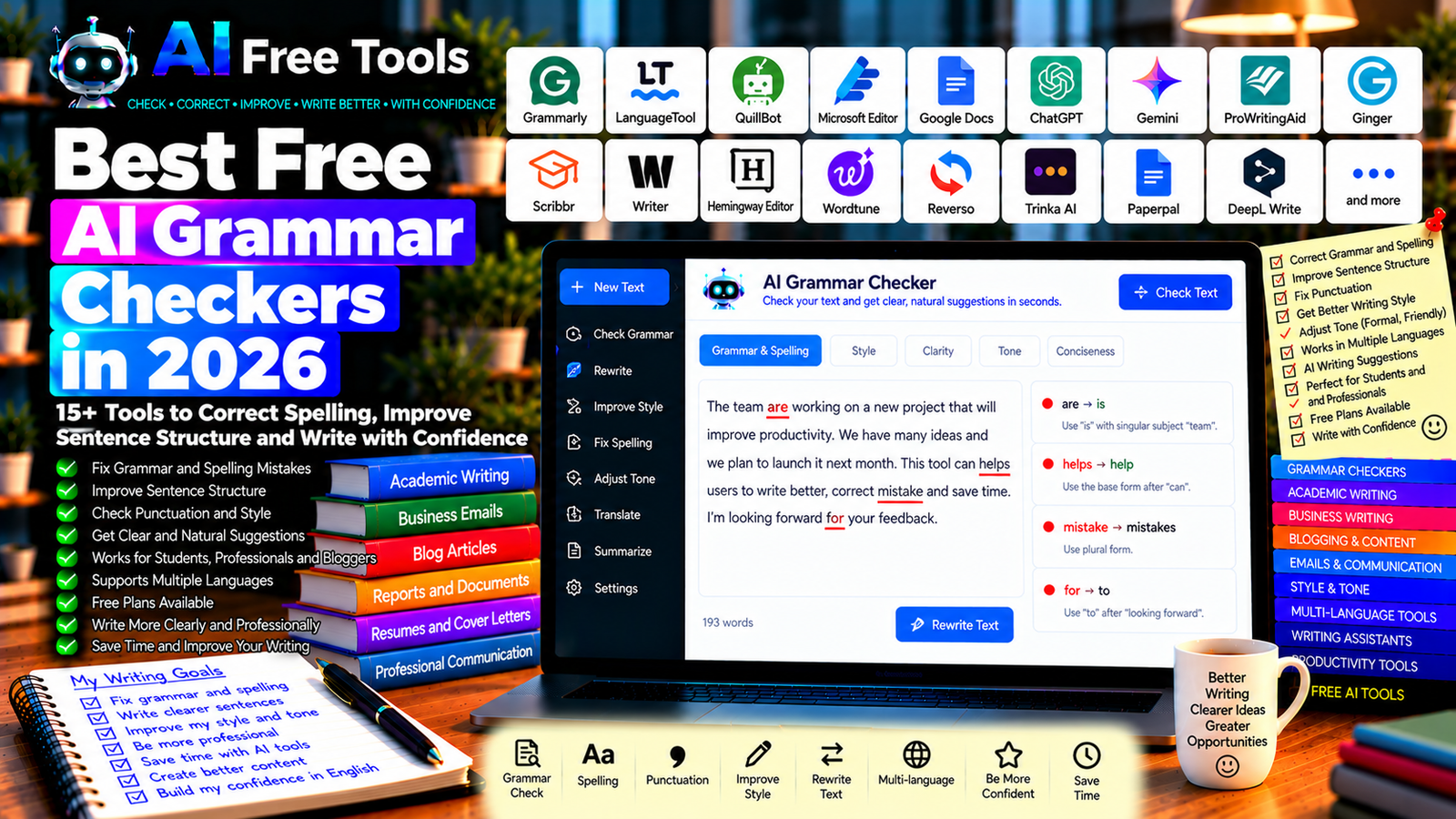
Best Free AI Grammar Checkers in 2026: 15+ Tools to Improve Your Writing
Writing clearly matters whether you are preparing a business email, a university assignment, a blog post, a product description, or a professional report. Spelling mistakes, punctuation errors, and awkward sentences can make your message harder to understand.
Free AI grammar checkers can help identify common writing problems and suggest improvements. Some focus on grammar and spelling, while others also review tone, readability, sentence structure, and word choice.
In this guide, we compare 17 grammar checkers and AI writing assistants in 2026. You will learn what each tool does best, which free features to investigate, and how to choose a solution for everyday writing, academic work, or professional communication.
Important: Not every tool listed here is a dedicated grammar checker. Some are general AI assistants or writing tools that can help review text. Free-plan limits and supported languages can change. AI suggestions may also be incorrect, so review proposed changes before accepting them.
Quick Comparison: Best Free AI Grammar Checkers
| Tool | Best For | Free Access |
|---|---|---|
| Grammarly | Everyday English grammar and spelling | Free plan with limits |
| LanguageTool | Multilingual grammar and spelling | Free plan with limits |
| QuillBot | Grammar checking and rewriting | Free features with restrictions |
| Microsoft Editor | Writing in Microsoft applications | Basic features; advanced features vary |
| Google Docs | Everyday writing and spelling checks | Core features generally available with a Google account |
| ChatGPT | Explaining and correcting writing problems | Free tier with limits |
| Google Gemini | Grammar feedback and rewriting | Free tier with limits |
| ProWritingAid | Detailed writing style feedback | Free usage may be limited |
| Ginger | Grammar and sentence correction | Free features and limits vary |
| Scribbr | Academic proofreading resources | Free tools and paid services vary |
| Writer | Business writing consistency | Free access and features may vary |
| Hemingway Editor | Readability and sentence clarity | Free web editor; other features may cost |
| Wordtune | Rewriting awkward sentences | Free usage may be limited |
| Reverso | Grammar, translation, and contextual examples | Free tools with limits |
| Trinka AI | Academic and technical writing | Free usage may be limited |
| Paperpal | Academic writing assistance | Free features and usage limits vary |
| DeepL Write | Improving wording and tone | Free access and supported languages may vary |
1. Grammarly — Best for Everyday English Writing
Grammarly is a popular writing assistant that checks spelling, grammar, punctuation, and clarity. Depending on the product and plan, it may also suggest improvements to tone and sentence structure.
It is useful for emails, articles, essays, reports, and many other types of English writing.
Best features:
- Detect common grammar and spelling errors.
- Identify punctuation problems.
- Suggest clearer wording.
- Review writing tone where available.
- Use supported browser and application integrations.
Free access: Grammarly offers a free plan with core writing suggestions. Advanced feedback and some AI features may require a paid plan.
Best for: Students, bloggers, professionals, freelancers, and people writing regularly in English.
Official website: https://www.grammarly.com/
2. LanguageTool — Best for Multilingual Grammar Checking
LanguageTool checks grammar, spelling, punctuation, and style in several supported languages. It is especially useful if you write in more than one language and need a tool that goes beyond English.
Best features:
- Check grammar and spelling.
- Detect punctuation mistakes.
- Review style and sentence structure.
- Support multiple languages.
- Use supported browser extensions and writing integrations.
Free access: LanguageTool offers a free version with limits on advanced suggestions and text length. Available features vary by language and plan.
Best for: Multilingual writers, students, translators, and professionals.
Official website: https://languagetool.org/
3. QuillBot — Best for Grammar Checking and Rewriting
QuillBot combines writing tools such as grammar checking, paraphrasing, and summarization. It can be useful when you want to correct a sentence and then explore a clearer way to express the same idea.
Best features:
- Check grammar and spelling.
- Rewrite sentences.
- Explore alternative wording.
- Improve clarity and readability.
- Use supported writing tools in one place.
Free access: QuillBot offers free tools with restrictions that may include text length, usage, or available modes.
Best for: Students, bloggers, professionals, and people who want to revise existing text.
Official website: https://quillbot.com/
4. Microsoft Editor — Best for Microsoft Applications
Microsoft Editor provides writing assistance for spelling, grammar, and clarity in supported Microsoft products and workflows. It can be convenient if you already write documents and emails in Word, Outlook, or compatible applications.
Best features to investigate:
- Correct spelling and grammar.
- Identify common writing problems.
- Improve clarity where supported.
- Use writing assistance in eligible applications.
- Review language and account-specific capabilities.
Free access: Basic writing assistance is available in some Microsoft products, while advanced suggestions and additional capabilities depend on the application and plan.
Best for: Office workers, students, and people who use Microsoft applications.
Official website: https://www.microsoft.com/microsoft-365
5. Google Docs — Best for Simple Everyday Corrections
Google Docs includes built-in spelling and grammar assistance that can help users correct common mistakes while writing. It is not exclusively an AI grammar checker, but it is a practical starting point for everyday documents.
Best features:
- Check spelling and supported grammar issues.
- Review suggested corrections.
- Collaborate on documents.
- Share and edit text online.
- Use additional writing assistance where eligible.
Free access: Core Google Docs features are generally available with a Google account. Advanced AI writing features depend on the account and plan.
Best for: Students, teachers, teams, and users who write in Google Workspace.
Official website: https://docs.google.com/
6. ChatGPT — Best for Understanding Grammar Mistakes
ChatGPT can review text, explain grammar rules, suggest corrections, and compare alternative sentences. Unlike a basic checker, you can ask why a sentence is incorrect and request examples that help you learn.
Best features:
- Correct grammar, punctuation, and spelling.
- Explain errors in simple language.
- Rewrite text while preserving its meaning.
- Adjust formality and tone.
- Review longer passages when supported by your current usage limits.
Free access: ChatGPT offers a free tier with usage and feature limits.
Best for: Students, English learners, bloggers, and professionals who want explanations as well as corrections.
Official website: https://chatgpt.com/
Example prompt:
“Check the text below for grammar, spelling, punctuation, and awkward sentence structure. First, provide a corrected version that preserves my original meaning and tone. Then list the important corrections and explain the grammar rules in simple English. Do not add new facts or rewrite the text more than necessary.”
7. Google Gemini — Best for Grammar Feedback and Rewriting
Google Gemini can review supplied text and suggest corrections, clearer wording, or alternative sentence structures. It can also explain why a change might improve readability.
Best features:
- Review grammar and spelling.
- Rewrite awkward sentences.
- Suggest alternative wording.
- Explain grammar rules.
- Adapt text to different audiences.
Free access: Gemini offers a free tier with usage limits. Available features depend on the account and current plan.
Best for: Students, professionals, multilingual writers, and people who already use Google services.
Official website: https://gemini.google.com/
8. ProWritingAid — Best for Detailed Writing Feedback
ProWritingAid provides grammar and style analysis, with features designed to help writers improve sentence structure, readability, and consistency. It may be particularly useful for longer articles and creative writing.
Best features to investigate:
- Detect grammar and spelling issues.
- Review repeated words and phrases.
- Analyze sentence structure.
- Improve readability and style.
- Explore supported writing integrations.
Free access: ProWritingAid offers limited free access, while advanced reports, longer text analysis, and other features may require a paid plan.
Best for: Bloggers, authors, editors, and people working on long-form content.
Official website: https://prowritingaid.com/
9. Ginger — Best for Sentence Correction
Ginger is a writing assistant focused on grammar correction, spelling, and sentence improvement. It can help identify common mistakes and suggest alternative wording.
Best features to investigate:
- Correct grammar and spelling.
- Suggest sentence corrections.
- Improve wording.
- Explore translation or rewriting features where supported.
- Check browser and application compatibility.
Free access: Ginger’s free features and usage limits can vary by platform and plan. Confirm current conditions before choosing it for frequent editing.
Best for: English learners, students, and users who want quick sentence corrections.
Official website: https://www.gingersoftware.com/
10. Scribbr — Best for Academic Writing Support
Scribbr is known for academic proofreading and writing resources. It offers tools and guidance that can help students review their writing, although some services are paid and not every feature is a general-purpose AI grammar checker.
Best features to investigate:
- Review grammar and spelling tools.
- Access academic writing guidance.
- Improve proofreading habits.
- Explore citation and plagiarism-related resources.
- Check the difference between free tools and paid editing services.
Free access: Some online tools and educational resources are available for free, while professional proofreading and other services may cost money.
Best for: University students, researchers, and academic writers.
Official website: https://www.scribbr.com/
11. Writer — Best for Consistent Business Writing
Writer provides AI writing and governance tools aimed at organizations. Depending on the current product and plan, it can help businesses apply consistent terminology, style, and language rules.
Best features to investigate:
- Review writing against style guidance.
- Improve consistency across business content.
- Support terminology preferences.
- Explore grammar and clarity assistance.
- Check team and organization features.
Free access: Availability of free access and individual features may change. Verify the current offering and whether it fits your intended use.
Best for: Businesses, content teams, and organizations that need consistent communication.
Official website: https://writer.com/
12. Hemingway Editor — Best for Readability and Clarity
Hemingway Editor focuses on making writing clearer and easier to read. It highlights issues such as overly complex sentences, excessive adverbs, and passive constructions.
It is a useful complement to a grammar checker because grammatically correct writing can still be difficult to understand.
Best features:
- Highlight difficult sentences.
- Identify overly complex wording.
- Review readability.
- Encourage concise writing.
- Improve clarity in articles and reports.
Free access: The web editor has offered free readability tools. Desktop software and some additional features may cost money.
Best for: Bloggers, journalists, marketers, and writers who want concise prose.
Official website: https://hemingwayapp.com/
13. Wordtune — Best for Rewriting Awkward Sentences
Wordtune is designed to improve wording by offering alternative ways to express an idea. It is particularly useful when a sentence is grammatically acceptable but sounds unnatural or unclear.
Best features:
- Rewrite sentences.
- Shorten or expand wording where supported.
- Explore alternative expressions.
- Adjust tone.
- Improve readability.
Free access: Wordtune offers access options with usage limits. Check current restrictions before using it for frequent editing.
Best for: Professionals, students, and writers who want more natural wording.
Official website: https://www.wordtune.com/
14. Reverso — Best for Language Support and Contextual Examples
Reverso offers translation, contextual examples, and language tools that can help users understand how expressions are used. Its grammar-related usefulness depends on the language and specific tool.
Best features:
- Explore translations and contextual examples.
- Check selected language-related issues.
- Compare expressions.
- Improve vocabulary choices.
- Support language learning workflows.
Free access: Reverso provides free tools with possible usage limits and advertisements. Some features may have separate conditions.
Best for: Language learners, translators, and multilingual writers.
Official website: https://www.reverso.net/
15. Trinka AI — Best for Academic and Technical Writing
Trinka AI focuses on grammar and language improvement for academic, technical, and formal writing. It may help identify issues that are especially relevant to research papers and professional documents.
Best features to investigate:
- Check grammar and formal writing style.
- Improve academic phrasing.
- Review technical text.
- Explore consistency and language checks.
- Use supported document or browser integrations.
Free access: Trinka offers access options with restrictions. Advanced features, document limits, and available integrations depend on the current plan.
Best for: Researchers, academics, technical writers, and students preparing formal documents.
Official website: https://www.trinka.ai/
16. Paperpal — Best for Academic Language Editing
Paperpal is an AI writing assistant focused on academic writing. It can help improve grammar, clarity, and language in research-related documents.
Best features to investigate:
- Correct grammar and language issues.
- Improve academic wording.
- Review sentence clarity.
- Explore writing support for research documents.
- Check supported manuscript workflows.
Free access: Paperpal offers features with possible usage limits, while some capabilities may require payment.
Best for: Researchers, graduate students, and academic writers.
Official website: https://paperpal.com/
17. DeepL Write — Best for Improving Wording and Tone
DeepL Write helps users refine text by suggesting alternative wording, improving fluency, and adjusting the style of supported languages. It can be useful when you want to make a message sound more natural rather than simply correct individual grammar errors.
Best features:
- Suggest alternative expressions.
- Improve sentence structure.
- Refine tone where supported.
- Make writing more fluent.
- Work alongside other DeepL language tools.
Free access: DeepL Write offers free access options, but language support, text limits, and additional features may vary by plan and region.
Best for: Professionals, multilingual writers, students, and people polishing business communication.
Official website: https://www.deepl.com/write
How to Choose the Best Free AI Grammar Checker
The right tool depends on the type of writing you produce, the languages you use, and whether you want simple corrections or detailed explanations.
| Your Main Goal | Recommended Starting Tools |
|---|---|
| Everyday English grammar | Grammarly or Microsoft Editor |
| Multiple languages | LanguageTool |
| Grammar explanations | ChatGPT or Gemini |
| Academic writing | Trinka AI or Paperpal |
| Clearer, shorter sentences | Hemingway Editor |
| Rewriting awkward text | QuillBot or Wordtune |
| Writing inside Google Docs | Google Docs built-in checks |
| Longer articles and manuscripts | ProWritingAid |
| Contextual language examples | Reverso |
Best Free AI Grammar Checkers for Students
Students need accurate grammar, clear explanations, and writing that follows academic requirements. Grammarly and LanguageTool are useful starting points for routine corrections, while ChatGPT can explain why a sentence needs improvement.
For research papers, consider tools focused on academic writing, such as Trinka AI or Paperpal. Always follow your institution’s rules about AI assistance and verify citations, quotations, and factual claims independently.
Best Free AI Grammar Checkers for Bloggers
Bloggers need writing that is readable, consistent, and easy to scan. Grammarly or LanguageTool can help catch common errors, while Hemingway Editor can identify sentences that are difficult to read.
For long articles, use a consistent editing workflow: check grammar, review readability, verify factual claims, and proofread headings and links before publishing. No grammar tool can guarantee that an article is accurate or optimized for search engines.
Best Free AI Grammar Checkers for Business Writing
Business writing often needs a professional tone and unambiguous wording. Grammarly, Microsoft Editor, and LanguageTool can help review emails, proposals, and reports.
For sensitive or contractual messages, do not rely solely on an AI rewrite. Verify names, dates, prices, commitments, and legal wording before sending the document.
How to Improve Your Writing with AI in Five Steps
Step 1: Write Your First Draft
Focus on communicating your ideas before trying to make every sentence perfect. A grammar checker is most useful when you already have a clear message to review.
Step 2: Run a Grammar and Spelling Check
Use a tool such as Grammarly, LanguageTool, or an editor built into your writing application to identify common mistakes.
Step 3: Review Clarity and Readability
Use a readability tool or AI assistant to identify long sentences, repetitive wording, and unclear explanations. Do not shorten a sentence if doing so removes important meaning.
Step 4: Check the Tone and Meaning
Make sure the writing fits the audience. A formal report, customer email, academic essay, and blog post should not necessarily sound the same.
Step 5: Proofread the Final Version
Read the corrected text carefully. Confirm that the tool has not changed the meaning, introduced unsupported claims, or altered important technical terms.
Example AI Prompt for Grammar Correction
Copy and adapt this prompt:
“Proofread the text below for grammar, spelling, punctuation, sentence structure, and clarity. Preserve my intended meaning, voice, and level of formality. First provide the corrected text. Then list the most important corrections and explain them briefly. Do not add new facts, remove necessary details, or rewrite sentences that are already correct unless there is a clear reason.”
Are Free AI Grammar Checkers Worth Using?
Yes. They can help identify mistakes, improve readability, and make writing more professional. They are especially useful for students, bloggers, freelancers, and people who regularly write in a second language.
For routine English corrections, start with Grammarly or Microsoft Editor. For multilingual writing, explore LanguageTool. For explanations, use ChatGPT or Gemini. For academic documents, investigate Trinka AI or Paperpal. For clearer sentences, consider Hemingway Editor.
The most effective approach combines automated checking with careful human review. A grammar checker can improve the language, but it cannot guarantee that your argument is correct, your facts are accurate, or your message is appropriate for every audience.
Are AI Grammar Checkers Safe for Private Documents?
Some writing tools process text through cloud services. If your draft contains personal information, client details, unpublished research, or confidential business information, review the provider’s privacy and data-retention policies before submitting it.
Consider these precautions:
- Avoid submitting sensitive information that is not needed for proofreading.
- Use an organization-approved tool for confidential documents.
- Review permissions before connecting a writing assistant to your email or document applications.
- Check whether text may be retained or used to improve AI systems.
- Verify all proposed changes before sharing the final document.
Frequently Asked Questions
What is the best free AI grammar checker in 2026?
The best option depends on your needs. Grammarly and LanguageTool are useful for routine corrections, ChatGPT can explain errors, Hemingway Editor focuses on readability, and Trinka AI or Paperpal may suit academic writing. Check current free-plan limits before choosing.
Can AI grammar checkers correct text for free?
Yes. Many tools offer free grammar and spelling checks, although advanced features, text limits, and usage allowances vary. Some general AI assistants can also review text through a free tier.
Are AI grammar checkers accurate?
They can catch many common errors, but they may misunderstand context, accept incorrect wording, or suggest changes that alter your meaning. Review corrections carefully, particularly in technical, academic, or legal writing.
Can AI grammar checkers support multiple languages?
Some tools, such as LanguageTool and Reverso, support multiple languages, but the quality and available features vary by language. Check the specific language before relying on the tool for important documents.
Is a grammar checker enough to improve an article’s SEO?
No. Grammar and readability are only part of producing a strong article. Search performance also depends on search intent, useful original information, site quality, technical SEO, internal links, and other factors.
Can I use AI grammar checkers for academic work?
They can help with proofreading and language clarity, but you should follow your institution’s rules. Verify references and quotations, preserve your own analysis, and disclose AI assistance when required.
Should I accept every AI correction?
No. Suggestions can be incorrect or inappropriate for your context. Accept changes that improve the text while preserving your meaning, and reject those that make it less accurate or less natural.
Final Verdict
The best free AI grammar checkers in 2026 can help you correct common errors, improve clarity, and write more confidently.
For everyday English, try Grammarly or Microsoft Editor. For multilingual support, consider LanguageTool. For grammar explanations, use ChatGPT or Google Gemini. For academic writing, explore Trinka AI or Paperpal, and for readability, try Hemingway Editor.
Choose a tool that supports your language and workflow, verify current free-plan restrictions, and review every suggested change before using the final text. The goal is not just to eliminate mistakes, but to communicate accurately and clearly.
Explore more guides on AI Free Tools:
Leave a Reply