
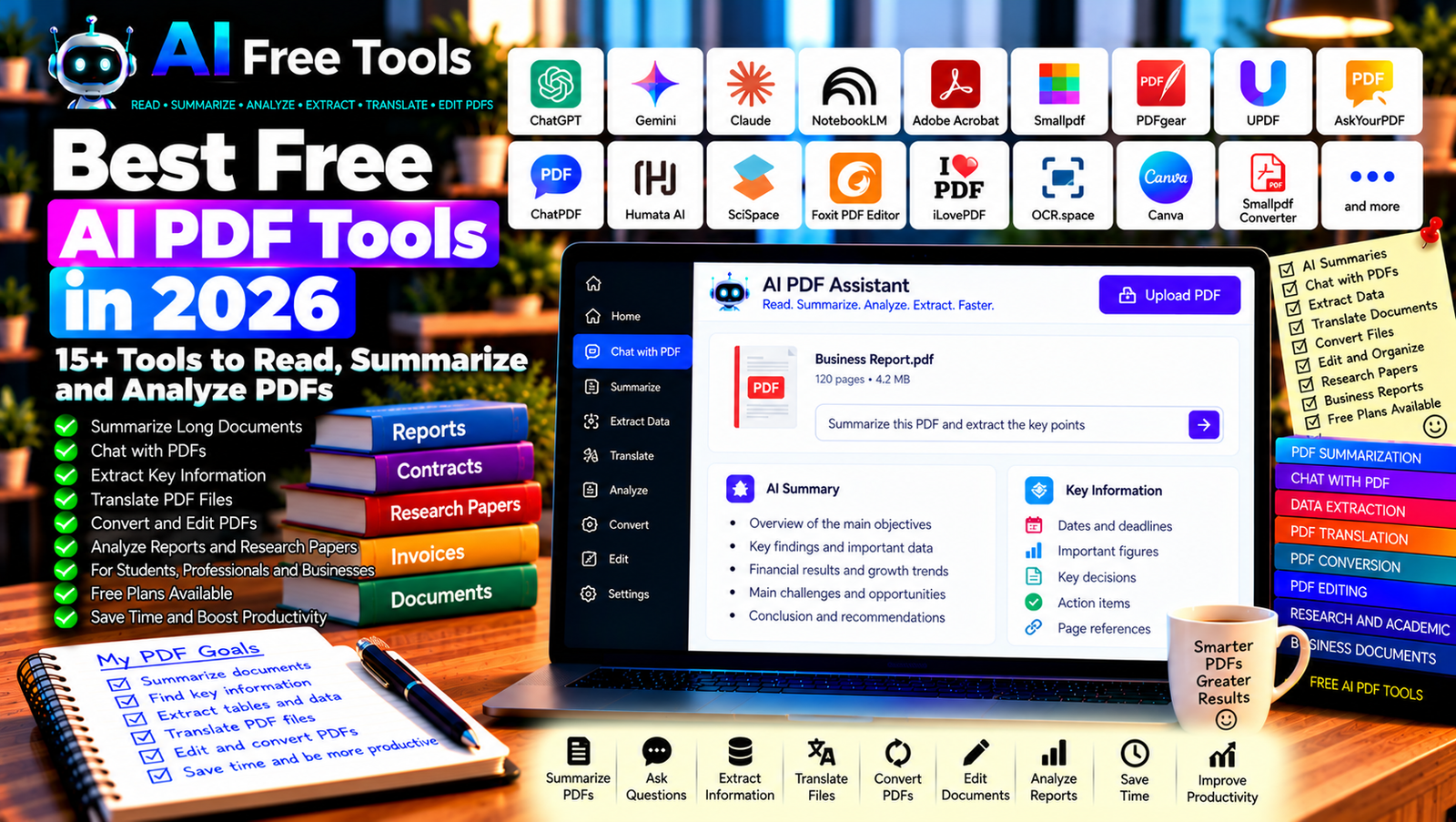
Best Free AI PDF Tools in 2026: 15+ Tools to Read, Summarize and Analyze PDFs
Free AI PDF tools can help you understand long documents, summarize reports, extract important information, and find answers inside PDF files without reading every page manually. They are useful for students reviewing course materials, professionals working with reports, researchers reading academic papers, and business owners managing contracts, invoices, and product documents.
Some tools allow you to ask questions about a PDF in natural language. Others focus on summarization, document conversion, translation, editing, or extracting tables and text. Choosing the right option depends on the type of PDF you have and what you want to do with it.
In this guide, we compare 17 AI assistants and PDF-related tools in 2026. You will discover their main uses, how to evaluate their free access, and which tools are worth trying for different workflows.
Important: Not every tool listed here is exclusively an AI PDF application. Some are general-purpose AI assistants or PDF editors with AI-related features. Free plans, file-size limits, page limits, and supported formats can change. Always check the current terms before uploading large or sensitive documents.
Quick Comparison: Best Free AI PDF Tools
| Tool | Best For | Free Access |
|---|---|---|
| ChatGPT | Asking questions about supported PDF files | Free tier with limits |
| Google Gemini | Summarizing and understanding documents | Free tier with limits |
| Claude | Analyzing long documents | Free tier with limits |
| Google NotebookLM | Working with multiple source documents | Free access with limits |
| Adobe Acrobat AI Assistant | PDF questions and document summaries | AI features may require payment |
| Smallpdf AI PDF | Summarizing and working with PDFs | Free tools with limits |
| PDFgear | PDF editing and AI-assisted reading | Free features; verify current terms |
| UPDF AI | Chatting with and summarizing PDFs | Free or trial limits may apply |
| AskYourPDF | Asking questions about documents | Free access with limits |
| ChatPDF | Chatting with PDF documents | Free plan with restrictions |
| Humata AI | Document questions and research | Free access with limits |
| SciSpace | Understanding academic papers | Free features with limits |
| Sharly AI | Summarizing and analyzing documents | Current free access varies |
| Foxit PDF Editor | PDF editing and document workflows | Free reader; advanced features may cost |
| iLovePDF | Converting, merging, and organizing PDFs | Free tools with limits |
| Smallpdf PDF Converter | Converting PDF files | Free access with restrictions |
| OCR.space | Extracting text from scanned documents | Free OCR access with limits |
1. ChatGPT — Best for Asking Questions About PDFs
ChatGPT can help summarize supported PDF files, explain difficult passages, extract key points, and answer questions about document content. It can be particularly useful when you need to understand a report without manually searching through every page.
Depending on the file and available features, you may also be able to compare sections, prepare notes, or transform information into a table.
Best features:
- Summarize supported PDF documents.
- Ask questions about document content.
- Extract important facts and key points.
- Explain technical or unfamiliar passages.
- Turn document information into structured notes.
Free access: ChatGPT offers a free tier with usage and feature limits. File uploads and advanced document analysis may be restricted.
Best for: Students, professionals, researchers, and small business owners.
Official website: https://chatgpt.com/
Example prompt:
“Analyze this PDF and summarize its main purpose, key findings, important figures, and conclusions. Identify the page or section supporting each important point when possible. Do not invent missing information, and clearly flag anything that cannot be verified from the document.”
2. Google Gemini — Best for Document Summaries and Explanations
Google Gemini can help users summarize document content, explain complex passages, and organize information into a more readable format. Supported file uploads and integrations depend on the current account and plan.
Best features:
- Summarize supported documents.
- Explain complex paragraphs.
- Extract key information.
- Organize findings into lists or tables.
- Support eligible Google Workspace workflows.
Free access: Gemini offers a free tier with usage limits. File support, upload limits, and advanced capabilities can vary.
Best for: Students, office workers, and people who need quick explanations of documents.
Official website: https://gemini.google.com/
3. Claude — Best for Long-Document Analysis
Claude can help analyze lengthy text and supported document uploads. It is useful when a PDF contains multiple sections, arguments, or technical details that need to be summarized carefully.
Best features:
- Summarize long documents.
- Compare sections and arguments.
- Extract important details.
- Explain technical content.
- Create structured outlines and notes.
Free access: Claude offers a free tier with usage limits. File sizes, available features, and the number of requests may depend on the current plan.
Best for: Researchers, writers, students, and professionals reviewing complex documents.
Official website: https://claude.ai/
4. Google NotebookLM — Best for Working with Multiple Documents
Google NotebookLM is an AI research assistant that works with supported source materials. It can help you understand several documents together and ask questions based on the sources you provide.
This can be particularly helpful when researching a topic using multiple reports, articles, or study documents.
Best features:
- Summarize supported source materials.
- Ask questions across multiple sources.
- Organize research notes.
- Identify connections between documents.
- Link answers to source references where supported.
Free access: NotebookLM offers free access with usage limits. Supported sources, quotas, and features can change.
Best for: Students, researchers, consultants, and professionals managing document collections.
Official website: https://notebooklm.google.com/
5. Adobe Acrobat AI Assistant — Best for PDF Workflows
Adobe Acrobat is a well-known PDF platform for reading, editing, organizing, and converting documents. Its AI Assistant can help users ask questions about PDFs and obtain summaries where the feature is available.
Best features to investigate:
- Summarize supported PDF documents.
- Ask questions about document content.
- Work with PDF editing and organization features.
- Convert and export supported files.
- Review source references where available.
Free access: Adobe offers free PDF-related tools and reader features, but AI Assistant access and usage may require a paid plan or eligible offer.
Best for: Professionals and businesses that already use Adobe Acrobat.
Official website: https://www.adobe.com/acrobat.html
6. Smallpdf AI PDF — Best for Summaries and Everyday PDF Tasks
Smallpdf provides browser-based tools for working with PDF documents, including conversion, compression, and other document workflows. AI-related features may help summarize or interact with supported PDFs.
Best features to investigate:
- Summarize supported PDF files.
- Explore document-related AI features.
- Compress PDF files.
- Convert supported file formats.
- Merge or split documents through available tools.
Free access: Smallpdf offers free tools with usage restrictions. Some AI features, processing limits, and advanced options may require a paid plan.
Best for: Students, freelancers, and office workers who regularly handle PDFs.
Official website: https://smallpdf.com/
7. PDFgear — Best for PDF Editing and Reading
PDFgear provides PDF reading and editing features, with AI-related capabilities available in supported versions. It may be useful if you want to manage document pages and work with PDF content in one application.
Best features to investigate:
- Read and organize PDF documents.
- Edit supported PDF content.
- Explore AI-assisted document summaries or questions.
- Convert PDFs into supported formats.
- Check desktop and mobile compatibility.
Free access: PDFgear has offered many free PDF features. Verify current AI capabilities, supported devices, and privacy terms before using it for important documents.
Best for: Students, office workers, and users who need a combination of PDF management and AI assistance.
Official website: https://www.pdfgear.com/
8. UPDF AI — Best for Chatting with and Summarizing PDFs
UPDF combines PDF editing tools with AI-related document workflows. Its AI features can help users summarize files, ask questions, and understand document content where supported.
Best features to investigate:
- Summarize PDF documents.
- Ask questions about a document.
- Translate or explain supported text.
- Edit and annotate PDFs.
- Organize document pages.
Free access: UPDF offers different plans and may provide limited trials or AI usage. Check current AI quotas and the cost of advanced PDF editing features.
Best for: Professionals and students who want document management and AI assistance together.
Official website: https://updf.com/
9. AskYourPDF — Best for Question-Based Document Research
AskYourPDF focuses on allowing users to interact with supported documents through questions. Rather than manually searching for a particular passage, you can ask for explanations or request a summary of the supplied content.
Best features to investigate:
- Ask questions about PDF content.
- Summarize supported documents.
- Extract information from source material.
- Explore document research workflows.
- Check available integrations and file formats.
Free access: AskYourPDF offers free access options with limits. File size, number of documents, and advanced features may depend on the current plan.
Best for: Students, researchers, and professionals reviewing reports or reference documents.
Official website: https://askyourpdf.com/
10. ChatPDF — Best for Simple PDF Conversations
ChatPDF lets users ask questions about supported PDF files. It can be useful when you want to locate an answer, understand a section, or obtain a short summary without reading the entire document first.
Best features:
- Ask questions about uploaded PDFs.
- Generate document summaries.
- Explore key information.
- Review answers alongside source references where supported.
- Use a conversational interface.
Free access: ChatPDF offers a free plan with restrictions that may include document counts, page limits, or daily usage. Check current terms before processing many files.
Best for: Students, professionals, and users who need a straightforward way to explore PDFs.
Official website: https://www.chatpdf.com/
11. Humata AI — Best for Research and Document Questions
Humata AI has focused on asking questions about documents and extracting information from supported files. It can be useful when reviewing technical reports, research material, or business documentation.
Best features to investigate:
- Ask questions about supported documents.
- Summarize source material.
- Extract relevant information.
- Explore document-based research workflows.
- Review source references where available.
Free access: Humata’s available plans and usage limits can change. Check the current pricing and supported document formats.
Best for: Researchers, students, and professionals working with multiple documents.
Official website: https://www.humata.ai/
12. SciSpace — Best for Academic PDFs
SciSpace provides tools to help users explore and understand scientific papers and academic literature. It can help explain technical passages, summarize research, and support literature-review workflows.
Best features:
- Explore scientific papers.
- Ask questions about supported research documents.
- Explain technical terminology.
- Summarize research content.
- Support literature-review workflows.
Free access: SciSpace offers free features with possible limits on document processing, AI queries, and advanced tools.
Best for: University students, researchers, and readers of scientific papers.
Official website: https://scispace.com/
13. Sharly AI — Best for Summarizing and Comparing Documents
Sharly AI has offered AI-assisted document reading and analysis workflows. Depending on its current features, it may help users summarize content, ask questions, or compare information from supported documents.
Best features to investigate:
- Summarize supported files.
- Ask questions about document content.
- Extract key information.
- Compare information from sources.
- Review available file formats and integrations.
Free access: Current availability, file limits, and pricing should be verified directly, as product offerings may change.
Best for: Professionals, researchers, and users who need to review multiple documents.
Official website: https://www.sharly.ai/
14. Foxit PDF Editor — Best for Professional PDF Management
Foxit provides PDF reading, editing, annotation, and document-management software. AI-related features may be available in eligible products or subscriptions.
Best features to investigate:
- Read and annotate PDF files.
- Edit supported document content.
- Organize pages and files.
- Convert PDFs into other formats.
- Explore AI-assisted document workflows where available.
Free access: Foxit offers PDF reader functionality and other access options, while advanced editing and AI features may require a paid plan.
Best for: Businesses, office workers, and professionals who handle PDFs regularly.
Official website: https://www.foxit.com/
15. iLovePDF — Best for Everyday PDF Management
iLovePDF provides browser-based tools for common PDF tasks. Although it is not primarily an AI assistant, it can be useful alongside AI tools when you need to prepare, organize, or convert documents.
Best features:
- Merge and split PDF files.
- Compress large documents.
- Convert supported formats.
- Rotate or organize pages.
- Explore available document-processing tools.
Free access: iLovePDF offers free tools with restrictions on task frequency, file size, or advanced functions. Check current limits before processing many documents.
Best for: Students, freelancers, and office workers.
Official website: https://www.ilovepdf.com/
16. Smallpdf PDF Converter — Best for Converting Documents
PDF conversion tools are useful when you need to transform a PDF into an editable Word document, spreadsheet, image, or another supported format before analyzing it with AI.
Smallpdf offers conversion workflows as part of its broader PDF toolkit.
Best features to investigate:
- Convert supported files to PDF.
- Convert PDFs into editable formats.
- Compress or organize documents.
- Prepare files for further analysis.
- Use browser-based workflows.
Free access: Free conversion may be restricted by daily usage, file size, or plan limits. Verify the current conditions before converting large batches.
Best for: Students and professionals who need to prepare documents for editing or analysis.
Official website: https://smallpdf.com/pdf-converter
17. OCR.space — Best for Extracting Text from Scanned PDFs
OCR.space provides optical character recognition tools that can extract text from supported images and scanned documents. This is particularly useful when a PDF contains photographed pages or scanned text that cannot be selected or copied.
OCR is different from summarization: it first converts visual text into machine-readable text, which you can then review or submit to an AI assistant for analysis.
Best features:
- Extract text from supported images.
- Process eligible scanned documents.
- Make scanned content searchable where supported.
- Support document-processing workflows.
- Check API options for automated extraction.
Free access: OCR.space offers free OCR access with limits. File size, usage quotas, and API restrictions may apply.
Best for: Researchers, students, and professionals working with scanned documents.
Official website: https://ocr.space/
How to Choose the Best Free AI PDF Tool
The right tool depends on whether you need to understand the content, edit the file, convert it, or extract text from a scan.
| Your Main Goal | Recommended Starting Tools |
|---|---|
| Ask questions about a PDF | ChatGPT, ChatPDF, or AskYourPDF |
| Summarize a long document | Claude, Gemini, or ChatGPT |
| Research across several documents | NotebookLM |
| Understand academic papers | SciSpace |
| Edit and organize PDF files | PDFgear, Adobe Acrobat, or Foxit |
| Convert or compress PDFs | Smallpdf or iLovePDF |
| Extract text from scanned pages | OCR.space |
| Review business reports | ChatGPT, Claude, or Gemini |
Best Free AI PDF Tools for Students
Students can use AI PDF tools to summarize readings, explain unfamiliar terminology, and prepare revision notes. ChatGPT, Gemini, Claude, and NotebookLM are worth exploring for document-based questions, while SciSpace is designed for academic research workflows.
Use summaries as study aids rather than replacements for the original material. Verify quotations, page references, equations, and claims before including them in assignments. Follow your institution’s policies on AI use.
Best AI PDF Tools for Business Documents
Businesses often handle quotations, product specifications, reports, invoices, contracts, and supplier documents. AI tools can help locate information and create summaries, while PDF editors can prepare files for review.
For example, a company could ask an AI assistant to extract product dimensions from a technical specification or summarize a supplier’s delivery conditions. The extracted details should still be checked against the original PDF before being used for purchasing or contractual decisions.
Best AI PDF Tools for Research
Research often involves reading multiple reports and comparing findings. NotebookLM, Claude, ChatGPT, and academic tools such as SciSpace can help organize information from supported sources.
Ask the tool to identify the source of each important claim. Then check the original pages, methodology, and limitations rather than relying exclusively on the generated summary.
How to Analyze a PDF with AI in Five Steps
Step 1: Prepare the File
Make sure the PDF opens correctly. If it consists of scanned pages, you may need an OCR tool to extract readable text before analyzing it.
Step 2: Define Your Goal
Decide whether you need a summary, a list of key facts, an explanation of technical terms, or answers to specific questions.
Step 3: Give Clear Instructions
Specify the required format, level of detail, and information that must be preserved. If you need figures or dates, explicitly ask the AI to retain them.
Step 4: Verify the Answers
Compare important answers with the original document. Check numbers, units, names, dates, page references, and qualifications.
Step 5: Protect Confidential Information
Before uploading a file, review the service’s privacy and retention terms. Use approved tools for confidential business records, personal information, or sensitive contracts.
Example AI Prompt for PDF Analysis
Copy and adapt this prompt:
“Analyze the attached PDF for [PURPOSE]. First, provide a concise summary. Then extract the key facts, important figures, dates, obligations, and conclusions relevant to my goal. Reference the original page or section when possible. Do not invent missing information. Clearly distinguish what the document states from your interpretation, and flag anything that needs manual verification.”
Are Free AI PDF Tools Worth Using?
Yes. They can reduce the time needed to review lengthy documents, locate specific information, and prepare summaries. The best choice depends on your main task.
For general document questions, start with ChatGPT, Gemini, or Claude. For multiple sources, explore NotebookLM. For academic papers, consider SciSpace. For PDF editing and conversion, compare PDFgear, Adobe Acrobat, Foxit, Smallpdf, and iLovePDF. For scanned documents, OCR.space may help extract text before further analysis.
Remember that AI can overlook a clause, misread a figure, or produce an incorrect summary. Always check the original document before making important academic, legal, financial, or business decisions.
Are AI PDF Tools Safe for Confidential Documents?
PDFs can contain personal information, financial records, contracts, customer details, and confidential business plans. When you upload a document, the service may process its contents on external systems.
Before uploading sensitive files, review the provider’s privacy policy, retention practices, data-use terms, and security controls. For confidential work, use an approved service and avoid uploading information that is not necessary for the task.
Frequently Asked Questions
What is the best free AI PDF tool in 2026?
The best option depends on your task. ChatGPT, Gemini, and Claude are flexible for document questions; NotebookLM is useful for multiple sources; ChatPDF and AskYourPDF focus on document conversations; and PDFgear or iLovePDF can help with PDF management. Check current free limits before choosing.
Can AI read a PDF and answer questions?
Yes, many AI assistants and document tools can answer questions about supported PDF files. Accuracy depends on document quality, file structure, and the tool’s capabilities. Verify important answers against the original text.
Can I summarize a PDF for free?
Some tools offer free summaries, but document size, page count, and usage may be limited. Check the current plan before uploading a large report or processing many files.
Can AI read scanned PDFs?
It depends on whether the tool supports scanned pages and optical character recognition. If the text is not selectable, use an OCR tool to extract it first. Always check the extracted text for recognition errors.
Can AI extract tables from PDF files?
Some tools can identify and extract tables from supported PDFs, but complex layouts may lead to errors. Check figures, row alignment, decimal separators, and units before copying extracted tables into a spreadsheet.
Are free AI PDF tools suitable for contracts?
They can help you locate and summarize clauses, but they should not replace qualified legal review. Verify every important clause against the original document and use a service approved for confidential information.
Can AI translate an entire PDF?
Some AI assistants and PDF applications support document translation, while others require you to extract or convert the text first. Formatting, language support, and file-size limits vary. Review the translated document carefully before using it.
Final Verdict
The best free AI PDF tools in 2026 can help you read, summarize, question, convert, and analyze documents more efficiently.
For general PDF questions, explore ChatGPT, Google Gemini, and Claude. For multiple research sources, consider NotebookLM. For academic papers, investigate SciSpace. For PDF editing and conversion, compare PDFgear, Adobe Acrobat, Smallpdf, and iLovePDF. For scanned documents, explore OCR.space.
Choose a tool that supports your file type and intended task, verify the current free-plan limits, and check important answers against the original PDF before relying on them.
Explore more guides on AI Free Tools:
Leave a Reply