
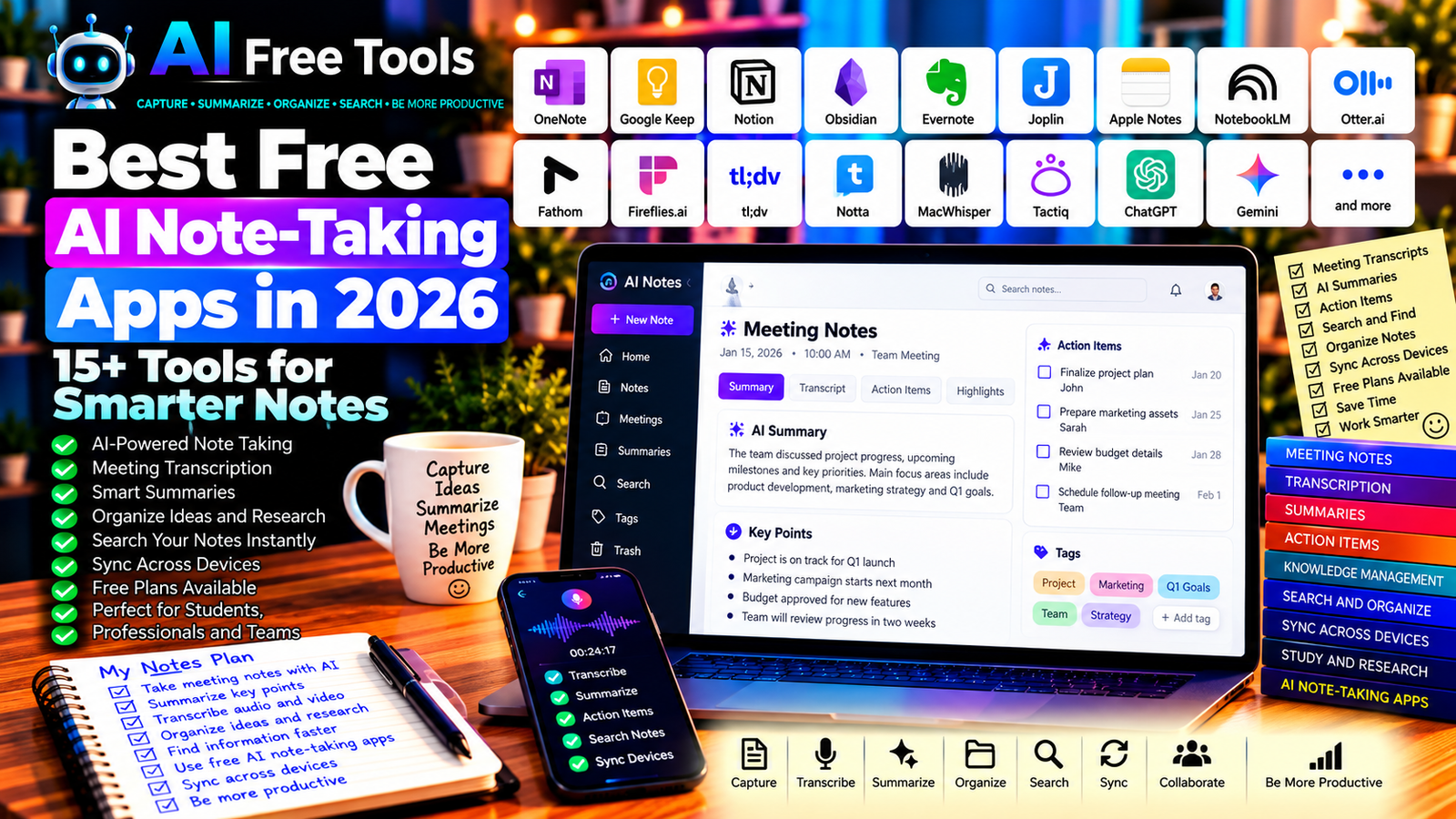
Best Free AI Note-Taking Apps in 2026: 15+ Tools for Smarter Notes
Free AI note-taking apps can help you capture ideas, summarize meetings, organize research, and find important information without spending hours reviewing handwritten notes or long recordings.
Whether you are a student, freelancer, business owner, or remote worker, the right note-taking app can make everyday work easier. Some tools focus on recording and transcribing meetings, while others organize personal knowledge, summarize documents, or turn scattered thoughts into structured notes.
In this guide, we compare 17 AI note-taking apps and related tools in 2026. You will learn what each tool does, what to check in its free plan, and how to choose the best option for your workflow.
Important: Not every app listed below includes unlimited AI note-taking in its free plan. Some are dedicated meeting assistants, while others are general note-taking apps that offer AI features or work alongside an AI assistant. Free allowances, supported languages, recording limits, and integrations can change, so check the current terms before signing up.
Quick Comparison: Best Free AI Note-Taking Apps
| Tool | Best For | Free Access |
|---|---|---|
| Microsoft OneNote | Organizing notes and research | Core features available free |
| Google Keep | Quick notes and reminders | Core features available free |
| Notion | Notes, databases, and knowledge management | Free plan; AI access varies |
| Obsidian | Personal knowledge management | Free for personal use |
| Evernote | Notes and document organization | Free access with restrictions |
| Joplin | Private, locally stored notes | Free and open source |
| Apple Notes | Notes within the Apple ecosystem | Core features available free |
| Google NotebookLM | Researching and summarizing sources | Free access with usage limits |
| Otter.ai | Meeting transcription and summaries | Free plan with limits |
| Fathom | Online meeting notes | Free access; terms may change |
| Fireflies.ai | Meeting transcription and search | Free plan with limits |
| tl;dv | Meeting recordings and summaries | Free access with restrictions |
| Notta | Transcription and meeting notes | Free plan with limits |
| MacWhisper | Audio transcription on compatible Macs | Free and paid options vary |
| Tactiq | Transcribing supported online meetings | Free plan with limits |
| ChatGPT | Turning information into structured notes | Free tier with limits |
| Google Gemini | Summarizing and organizing information | Free tier with limits |
1. Microsoft OneNote — Best for Organizing Everyday Notes
Microsoft OneNote is a digital notebook that lets you organize information into notebooks, sections, and pages. It is useful for collecting meeting notes, research, checklists, project information, and personal ideas.
You can combine OneNote with an AI assistant to summarize text, reorganize notes, or create action lists from meeting minutes.
Best features:
- Organize notes into notebooks and sections.
- Add text, images, links, and supported attachments.
- Search across saved notes.
- Synchronize notes across supported devices.
- Use eligible Microsoft AI features where available.
Free access: Core OneNote features are available free. Some Microsoft 365 integrations and AI capabilities require an eligible subscription.
Best for: Students, professionals, business owners, and people who prefer a structured notebook.
Official website: https://www.onenote.com/
2. Google Keep — Best for Quick Notes and Reminders
Google Keep is a lightweight note-taking service for capturing ideas, lists, reminders, and short pieces of information. It is useful when you need to save something quickly rather than organize it in a complex knowledge system.
For AI-assisted organization, you can copy your notes into a compatible AI assistant and ask it to group related ideas or create a task list.
Best features:
- Capture quick notes and checklists.
- Organize notes with labels and colors.
- Set supported reminders.
- Search saved information.
- Access notes across supported devices.
Free access: Core Google Keep features are available free with a Google account. AI capabilities may require separate tools or eligible integrations.
Best for: Students, freelancers, busy professionals, and people who need a simple note-taking system.
Official website: https://keep.google.com/
3. Notion — Best for Notes and Knowledge Management
Notion combines notes, documents, databases, task lists, and project pages in one workspace. It is useful for organizing information that needs to remain connected, such as meeting minutes, research notes, content plans, and business procedures.
AI features can help summarize or rewrite content, but availability and usage allowances depend on the current plan.
Best features:
- Create structured notes and documents.
- Build databases and knowledge libraries.
- Organize information with tags and linked pages.
- Collaborate with other users.
- Explore eligible AI writing and summarization features.
Free access: Notion offers a free plan. AI availability and limits may vary, so do not assume that all AI features are included without payment.
Best for: Freelancers, students, entrepreneurs, researchers, and teams managing a large amount of information.
Official website: https://www.notion.so/
4. Obsidian — Best for Personal Knowledge Management
Obsidian is a note-taking application built around local Markdown files and links between notes. It helps users create a personal knowledge base in which ideas, research, and references can be connected.
Obsidian is not primarily an AI transcription service. You can use it alongside an AI assistant to summarize research, generate outlines, or turn rough notes into structured documents.
Best features:
- Store notes as Markdown files.
- Link related notes together.
- Create a connected personal knowledge base.
- Search and organize information.
- Extend the workflow with community plugins.
Free access: Obsidian is free for personal use. Some optional services and commercial-use arrangements may have different terms. Third-party AI plugins may require API keys or paid services.
Best for: Researchers, writers, students, developers, and people building a long-term knowledge library.
Official website: https://obsidian.md/
5. Evernote — Best for Notes and Document Organization
Evernote is a note-taking platform designed to store information, organize documents, and make saved content searchable. Depending on the current plan, it may offer features for organizing notes, capturing documents, and managing tasks.
Best features:
- Create and organize notes.
- Save reference material and supported attachments.
- Search stored information.
- Organize notes into notebooks.
- Explore available AI-powered search or organization features.
Free access: Evernote’s free plan has restrictions, which may include device, usage, or feature limits. Check the current plan before importing a large archive of notes.
Best for: Professionals, researchers, students, and users who save many documents and references.
Official website: https://evernote.com/
6. Joplin — Best Free and Open-Source Note-Taking
Joplin is an open-source note-taking application that supports notebooks, Markdown, and attachments. It is a good choice for users who prefer control over their files and want a flexible note-taking system.
Joplin does not require a built-in AI subscription for basic note-taking. AI can be added separately through suitable tools or workflows, depending on your technical requirements.
Best features:
- Create Markdown notes and notebooks.
- Attach files to notes.
- Search and organize information.
- Choose supported synchronization options.
- Extend functionality through available plugins.
Free access: Joplin’s core application is free and open source. Optional cloud services and third-party integrations may have separate costs.
Best for: Privacy-conscious users, students, researchers, and people who want a flexible note-taking system.
Official website: https://joplinapp.org/
7. Apple Notes — Best for Apple Device Users
Apple Notes provides a straightforward way to capture notes, checklists, scans, and reference information across supported Apple devices.
Depending on the device, operating system, language, and region, some Apple Intelligence features may assist with summarization or rewriting. These features are not available on every device or account.
Best features:
- Capture notes and checklists.
- Organize notes into folders.
- Search and retrieve saved information.
- Scan supported documents.
- Use eligible system-level writing and summarization features.
Free access: Core Apple Notes features are available without a separate subscription on supported Apple devices. AI features have device and availability requirements.
Best for: iPhone, iPad, and Mac users who want a simple integrated note-taking experience.
Official website: https://www.apple.com/notes/
8. Google NotebookLM — Best for Research and Source Summaries
Google NotebookLM is an AI research assistant designed to help users work with supplied sources. It can summarize supported documents, answer questions based on those materials, and help organize research.
Although it is not a traditional notebook for every everyday task, it is especially useful when your notes depend on several documents, reports, or reference sources.
Best features:
- Work with supported source materials.
- Summarize uploaded or linked sources.
- Ask questions about your sources.
- Generate structured study or research notes.
- Help identify relevant information across documents.
Free access: NotebookLM offers free access with usage limits. Source limits, supported formats, and advanced features may vary.
Best for: Students, researchers, writers, consultants, and professionals who work with documents.
Official website: https://notebooklm.google.com/
9. Otter.ai — Best for Meeting Transcription
Otter.ai focuses on transcribing conversations and helping users review meeting content. It can be useful when you need a searchable record of discussions, interviews, or online meetings.
Its ability to join meetings, record audio, and generate summaries depends on the platform, permissions, and current plan.
Best features:
- Transcribe supported conversations.
- Search meeting transcripts.
- Generate summaries and action items.
- Review important statements.
- Integrate with supported meeting platforms.
Free access: Otter.ai offers a free plan with limits on transcription minutes, imports, and other features. Check current allowances before recording lengthy meetings.
Best for: Remote workers, students, interviewers, and teams that need meeting records.
Official website: https://otter.ai/
10. Fathom — Best for Meeting Summaries
Fathom is a meeting assistant designed to record supported online meetings and produce summaries. It can help users review key discussion points without replaying an entire conversation.
Always check whether recording is permitted and inform participants when required.
Best features:
- Record supported online meetings.
- Generate meeting summaries.
- Identify action items where supported.
- Search or review meeting information.
- Integrate with eligible meeting and productivity tools.
Free access: Fathom has offered free meeting-assistant features, but current limits and plan conditions may change. Check the latest terms for your intended use.
Best for: Sales teams, consultants, remote workers, and professionals who attend frequent online meetings.
Official website: https://fathom.video/
11. Fireflies.ai — Best for Searchable Meeting Records
Fireflies.ai is designed to record, transcribe, and summarize supported meetings. Its searchable transcripts can help users find decisions, topics, and follow-up actions after a discussion.
Best features:
- Transcribe supported meetings.
- Generate summaries.
- Search conversation records.
- Identify action items where supported.
- Connect to eligible productivity applications.
Free access: Fireflies.ai offers a free plan with limits on storage, transcription, AI features, or integrations. Check the current allowance before importing a large meeting archive.
Best for: Teams, consultants, sales professionals, and project managers.
Official website: https://fireflies.ai/
12. tl;dv — Best for Meeting Highlights and Recaps
tl;dv is a meeting recording and transcription tool for supported online meeting platforms. It can help teams create summaries, revisit important sections, and share relevant meeting information.
Best features:
- Record supported online meetings.
- Generate transcripts and summaries.
- Find relevant meeting moments.
- Share clips or highlights where supported.
- Integrate with selected productivity tools.
Free access: tl;dv offers free access with restrictions that may affect recording, AI summaries, or integrations. Check current plan details before choosing it for a team.
Best for: Remote teams, recruiters, consultants, and people who need searchable meeting records.
Official website: https://tldv.io/
13. Notta — Best for Audio Transcription and Notes
Notta provides transcription and meeting note features for supported audio, video, and meeting workflows. It can help turn spoken information into text that you can review and organize.
Best features:
- Transcribe supported audio.
- Generate meeting summaries where available.
- Review and search transcripts.
- Work with supported languages.
- Export or share information through eligible options.
Free access: Notta offers a free plan with restrictions on transcription duration, imports, or other features. Supported languages and allowances can change.
Best for: Students, interviewers, journalists, researchers, and professionals who work with recorded conversations.
Official website: https://www.notta.ai/
14. MacWhisper — Best for Local Audio Transcription on Mac
MacWhisper is a transcription application for compatible Mac computers. It uses speech-recognition models to turn supported audio into text, which can then be edited or organized into notes.
Local processing can be useful for privacy, but actual privacy depends on the selected model, configuration, and any online services used.
Best features to investigate:
- Transcribe supported audio files.
- Export transcripts for note-taking.
- Work with supported speech-recognition models.
- Review available local-processing options.
- Choose a workflow suited to your Mac and audio files.
Free access: MacWhisper offers free and paid options, with capabilities depending on the version and model.
Best for: Mac users, researchers, journalists, students, and people transcribing recorded interviews.
Official website: https://goodsnooze.gumroad.com/
15. Tactiq — Best for Transcribing Supported Online Meetings
Tactiq is a meeting transcription tool designed for supported online meeting environments. It can help capture conversation text and make it easier to review what was discussed.
Its capabilities depend on the browser, meeting platform, permissions, and current plan.
Best features:
- Capture supported meeting transcripts.
- Review conversation text.
- Generate summaries through available features.
- Identify follow-up actions where supported.
- Export or connect notes through eligible integrations.
Free access: Tactiq offers free access with usage limits. Check current transcription allowances and supported integrations before using it for frequent meetings.
Best for: Remote workers, recruiters, project managers, and teams that need searchable meeting notes.
Official website: https://tactiq.io/
16. ChatGPT — Best for Turning Rough Notes into Structured Information
ChatGPT can help transform rough notes into organized documents. You can paste meeting minutes, research notes, or a list of ideas and ask for a summary, action items, questions, or a follow-up email.
It is not a dedicated recording application, so you must provide the information or use a supported input method.
Best features:
- Summarize supplied notes.
- Turn discussions into action lists.
- Organize information by topic.
- Create meeting minutes and follow-up emails.
- Explain complex notes in simpler language.
Free access: ChatGPT offers a free tier with usage and feature limits.
Best for: Students, business owners, freelancers, researchers, and professionals.
Official website: https://chatgpt.com/
Example prompt:
“Turn the following meeting notes into a professional summary. Include the meeting objective, key decisions, unresolved questions, action items, responsible people, and deadlines. Do not invent missing names or dates. Mark any unclear information as ‘Needs confirmation.’”
17. Google Gemini — Best for Summarizing and Organizing Information
Google Gemini can help summarize supplied text, reorganize ideas, and produce structured notes. It can be useful when you need to transform long information into a concise outline or action list.
Available integrations and file-handling features depend on your account and current plan.
Best features:
- Summarize supplied information.
- Create structured outlines.
- Turn notes into checklists.
- Compare and organize ideas.
- Support eligible Google productivity workflows.
Free access: Gemini offers a free tier with usage limits. Advanced features and integrations may require an eligible plan.
Best for: Students, professionals, researchers, and users of Google productivity tools.
Official website: https://gemini.google.com/
How to Choose the Best Free AI Note-Taking App
The best choice depends on whether you mainly capture quick ideas, organize long-term knowledge, record meetings, or research documents.
| Your Main Goal | Recommended Starting Tools |
|---|---|
| Capture quick notes and reminders | Google Keep |
| Organize notebooks and study notes | OneNote |
| Build a connected knowledge base | Obsidian or Notion |
| Summarize research documents | NotebookLM |
| Transcribe online meetings | Otter.ai, Fireflies.ai, or tl;dv |
| Transcribe supported audio files | Notta or MacWhisper |
| Turn rough notes into action items | ChatGPT or Gemini |
| Use open-source note-taking software | Joplin |
Best Free AI Note-Taking Apps for Students
Students often need to organize lecture notes, research sources, reading lists, and revision materials.
OneNote and Google Keep are practical for everyday note capture. NotebookLM can help organize information from supported source materials, while ChatGPT or Gemini can turn supplied notes into summaries and revision questions.
Always verify important facts against the original material. Use AI as a study aid, and follow your institution’s rules for assignments and research.
Best AI Note-Taking Apps for Meetings
If you attend frequent online meetings, a dedicated meeting assistant may save more time than a general note-taking application.
Otter.ai, Fireflies.ai, Fathom, tl;dv, Notta, and Tactiq offer different transcription and meeting-summary workflows. Compare their supported platforms, language coverage, recording limits, export options, and free allowances.
Before recording a meeting, obtain the necessary consent and follow applicable workplace and privacy rules.
Best Free AI Note-Taking Apps for Business Owners
Business owners often need to capture supplier discussions, customer requirements, planning sessions, and operational decisions.
A simple setup might combine OneNote or Notion for storing documents with a meeting assistant for eligible online meetings. An AI assistant can then help transform approved notes into action lists, follow-up emails, and project tasks.
Keep confidential business information protected and verify important commitments before acting on AI-generated summaries.
How to Take Better Notes with AI in Five Steps
Step 1: Capture the Original Information
Save the meeting notes, source document, lecture notes, or ideas you want to organize. Include the date and context where useful.
Step 2: Choose the Right Tool
Use a traditional note-taking app for ongoing organization, a transcription tool for recorded speech, or a source-focused research assistant for documents.
Step 3: Ask for a Specific Output
Instead of simply asking for a summary, specify whether you need decisions, action items, deadlines, definitions, questions, or a short executive summary.
Step 4: Review the Results
Check names, dates, decisions, figures, and technical terms. AI can misunderstand speech, omit context, or create an incorrect connection between two points.
Step 5: Store and Follow Up
Save the reviewed notes in a consistent location. Transfer tasks to your project management app and follow up on unresolved questions.
Example AI Prompt for Meeting Notes
Copy and adapt this prompt:
“Organize the following meeting notes into five sections: Summary, Key Decisions, Action Items, Open Questions, and Next Meeting. For each action item, include the responsible person and deadline only if explicitly stated. Do not invent information. Flag ambiguous statements and preserve important figures, dates, and technical terms.”
Are Free AI Note-Taking Apps Worth Using?
Yes. They can help you capture information, reduce the time spent reviewing long conversations, and make your notes easier to search and reuse.
For simple notes, Google Keep and OneNote are practical starting points. For research, NotebookLM may be useful. For meeting transcription, compare tools such as Otter.ai, Fireflies.ai, and tl;dv. For organizing rough notes, ChatGPT and Gemini can help produce structured summaries.
However, automatic transcripts and summaries are not always accurate. Review important information before sharing it, assigning tasks, or making decisions.
Are AI Note-Taking Apps Safe for Confidential Information?
Meeting recordings and notes may contain personal data, client information, financial figures, internal plans, or confidential discussions.
Before uploading recordings or documents, review the provider’s privacy terms, storage practices, and data-processing options. Obtain any required consent before recording conversations, and avoid uploading sensitive information to services that have not been approved for that purpose.
For critical meetings, keep the original recording or source notes when permitted so that you can verify the summary.
Frequently Asked Questions
What is the best free AI note-taking app in 2026?
The best choice depends on your needs. OneNote and Google Keep are useful for everyday notes, NotebookLM is worth exploring for source-based research, and Otter.ai or Fireflies.ai may suit meeting transcription. Free-plan limits vary.
Can AI take notes during a meeting?
Some meeting assistants can transcribe supported online meetings and generate summaries. Their operation depends on the meeting platform, permissions, subscription, and recording settings. Inform participants and obtain any required consent.
Can AI summarize handwritten or typed notes?
AI assistants can summarize typed text and some supported images or documents. Handwriting recognition depends on the application, image quality, language, and device. Review the result for transcription errors.
Are AI meeting summaries accurate?
They can be useful, but they may miss context, misidentify speakers, or misunderstand technical terms. Check decisions, names, dates, and action items against the original conversation before relying on them.
Can I use AI note-taking tools for university?
Yes, as a study aid, subject to your institution’s rules. They can help organize lecture notes and summarize sources, but you should verify information and avoid submitting AI-generated work in ways that violate academic policies.
Which note-taking app works offline?
Obsidian and Joplin support local note-taking workflows, while offline capabilities in other applications depend on the device and configuration. AI features often require an internet connection unless a supported local model is used.
Do free AI note-taking apps have recording limits?
Many transcription and meeting assistants restrict free usage through monthly minutes, file limits, storage, or AI credits. Check the current plan before relying on a tool for long recordings or daily meetings.
Final Verdict
The best free AI note-taking apps in 2026 can help you capture ideas, organize research, transcribe meetings, and turn unstructured information into useful action items.
For everyday notes, start with Microsoft OneNote or Google Keep. For a connected knowledge base, consider Obsidian or Notion. For research documents, try Google NotebookLM. For meeting transcription, compare Otter.ai, Fireflies.ai, and tl;dv. To turn rough notes into clear summaries and checklists, use ChatGPT or Google Gemini.
Choose the tool that fits your workflow, verify its free-plan limits, and review AI-generated notes before relying on them. Protect confidential information and obtain appropriate consent before recording meetings.
Explore more guides on AI Free Tools:
Leave a Reply